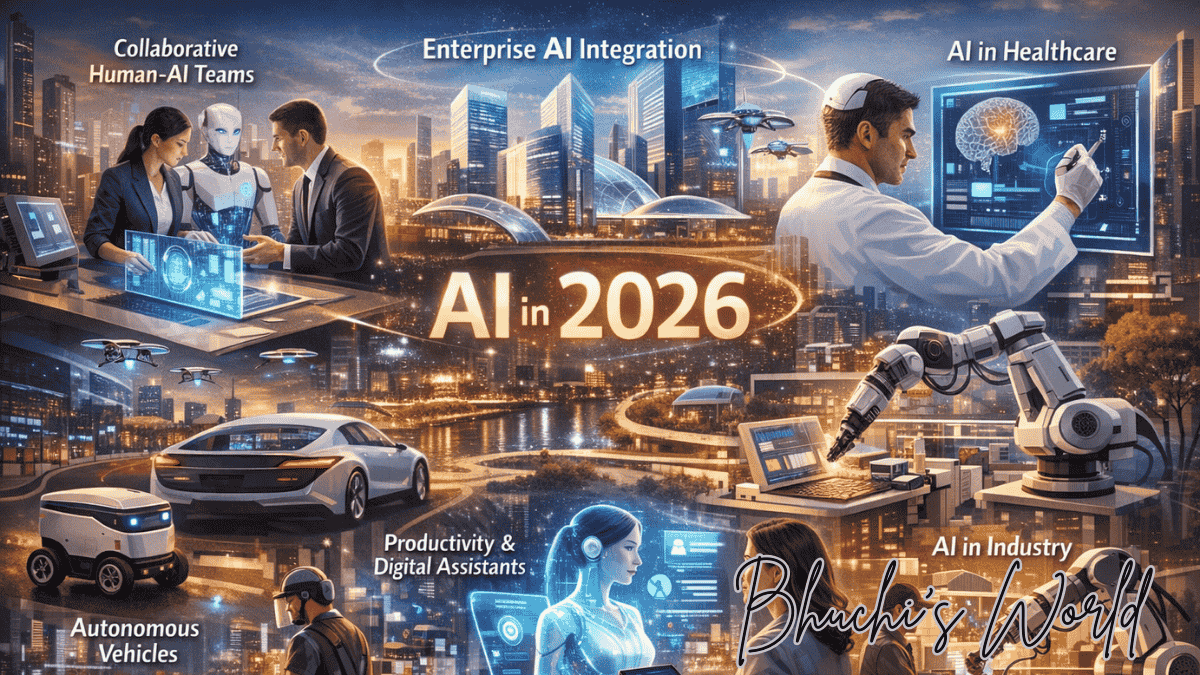
Future of AI in 2026: Predictions, Automation, and Technology Trends
By 2026, artificial intelligence won’t feel like a breakthrough anymore.
It’ll feel like electricity.
You won’t stop to admire it. You won’t even notice it most of the time. It’ll just work—silently powering your phone, your car, your job, and the small decisions you didn’t realize you were outsourcing.
You won’t wake up thinking, “AI is changing the world.”
You’ll wake up thinking, “How did my phone know I was running late—and already suggest coffee?”
That’s the real future of AI in 2026.
Not flashy demos. Not sci-fi robots. Not doomsday headlines.
Just systems that predict, assist, automate, and quietly remove friction from everyday life—until life feels smoother, faster, and a little suspiciously convenient.
No hype.
No panic.
No robot apocalypse countdown.
Just AI becoming invisible… and indispensable.
Why 2026 Is a Turning Point for AI
Until now, AI has mostly been:
Experimental
Inconsistent
Occasionally impressive
Occasionally… very confused
(Yes, the phase where AI confidently explains imaginary facts.)
By 2026, that phase ends.
Models Get Smarter (and Humbler)
AI systems in 2026 are far more accurate, context-aware, and—most importantly—willing to say “I’m not sure.”
“A marketing manager asks an AI tool to forecast next quarter’s campaign performance. Instead of guessing, the system flags missing data, asks for clarification, and provides confidence ranges rather than a single “perfect” answer. Fewer hallucinations. More honesty.”
AI Escapes the Tech Bubble
AI stops being a “tech team experiment” and becomes standard infrastructure across industries.
“A small clinic uses AI to summarize patient histories before appointments. Teachers use AI to adapt lesson plans to individual student progress. HR teams use it to screen resumes fairly—without turning hiring into a keyword lottery.”
No Silicon Valley hype—just daily usefulness.
Governments Finally Catch Up
By 2026, most regions have clear rules around AI usage, data protection, and accountability.
“AI tools are required to explain decisions in areas like loan approvals, insurance, and hiring. Companies must disclose when AI is used—and users can opt out. It’s not perfect regulation, but it’s enough to stop reckless experimentation.”
Users Raise the Bar
People stop accepting AI that wastes time, tracks everything, or pushes unnecessary upsells.
“A productivity app loses users because its AI sends irrelevant notifications. A competitor wins by offering quieter, privacy-first AI that steps in only when needed. Helpful beats loud.”
The Shift That Matters Most
AI stops trying to impress.
AI starts trying to help.
In 2026, the best AI doesn’t feel powerful.
It feels reliable.
And that’s when it truly changes everything.
What Artificial Intelligence Means in 2026
In 2026, AI is not a robot with feelings, not a super-genius plotting to replace humans, and definitely not magic (sadly, no spells involved). It doesn’t think or feel—it processes data. Very fast data. Impressively fast. But still data, not emotions or intuition.
At its core, AI learns patterns, makes predictions, suggests actions, and happily takes over repetitive tasks—the kind that make humans stare at screens questioning their life choices. It’s excellent at speed, consistency, and scale, especially when the work is predictable and boring.
The best way to picture AI is as a very fast assistant. It never gets tired, never asks for coffee breaks, and can work 24/7 without complaining. That said, it occasionally misunderstands context, misses sarcasm completely, and confidently delivers the wrong answer—so yes, it needs supervision, just like every assistant ever.
The smartest way to use AI isn’t to replace people, but to clear the clutter. Let AI handle the dull, repetitive stuff, while humans focus on creativity, judgment, empathy, and meaning—the things machines still can’t do, no matter how confident they sound.
AI Predictions 2026: How Daily Life Changes (Without Drama)
AI at Home: Less Effort, Fewer Decisions
By 2026, AI-powered homes aim to reduce mental load.
Your home will:
Adjust lights and temperature automatically
Optimize energy use (and bills)
Improve security quietly
Remind you of things you’d otherwise forget
Not because it’s “smart,” but because it pays attention.
AI doesn’t want control. It wants efficiency—and maybe a little appreciation.
AI in Healthcare: Fewer Surprises, More Prevention
Healthcare is where AI becomes genuinely life-changing.
By 2026, AI helps:
Detect health risks earlier
Analyze medical data faster than humans can
Assist doctors with second opinions
Support remote health monitoring
Important note:
AI does not replace doctors. It just helps them sleep better at night knowing fewer things slip through the cracks.
And yes, your smartwatch might know you’re stressed before you do. That’s not judgment. That’s data.
Also Read: The Future of AI Is Changing Everything from Jobs to Justice
AI in Education: Finally, No One-Size-Fits-All
Education in 2026 becomes more personal and less stressful.
AI enables:
Lessons that adjust to your learning speed
Early identification of gaps
Skill-focused learning beyond exams
Less paperwork for teachers (they deserve it)
Students learn differently. AI finally accepts that instead of pretending everyone learns best at the same pace on the same Tuesday morning.
Automation Future of AI in 2026: Let’s Talk About Jobs
Automation always brings fear. Understandably.
But here’s the honest picture.
What Automation Replaces
Automation replaces tasks that are:
Repetitive
Predictable
Boring (and you know it)
Examples:
Manual data entry
Routine reporting
Simple monitoring tasks
What Automation Creates
Automation increases demand for:
Creative thinkers
Problem-solvers
AI supervisors
Human-centered roles
Jobs don’t disappear overnight. They evolve slowly and inconveniently, like software updates you keep postponing.
The safest careers in 2026 belong to people who:
Learn continuously
Think critically
Work well with both humans and machines
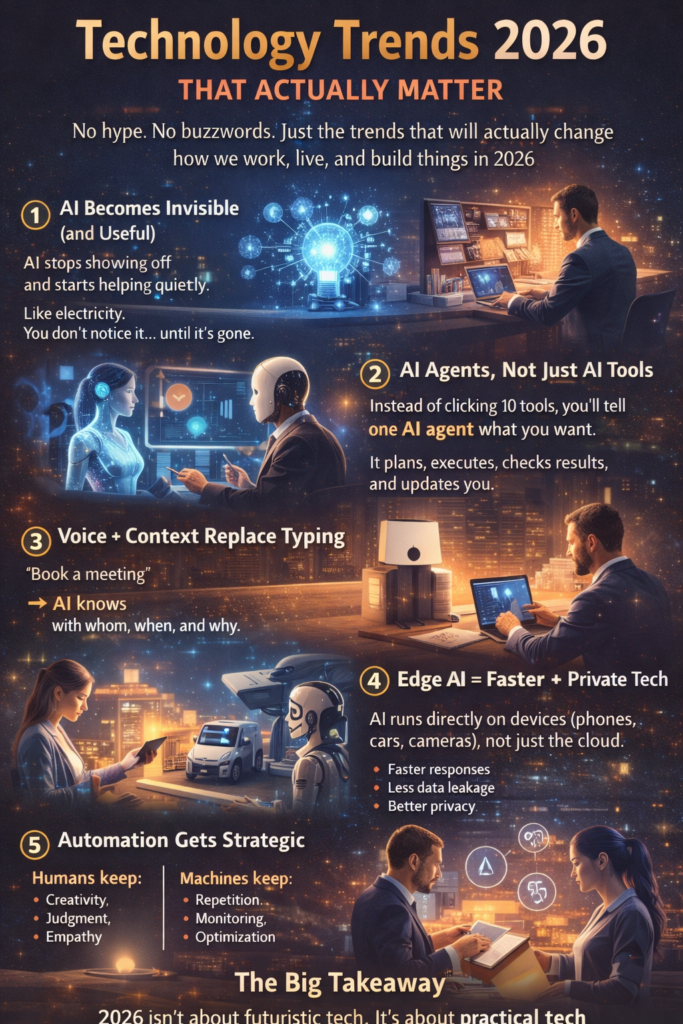
Technology Trends 2026 That Actually Matter
AI Everywhere (But Invisible)
By 2026, AI fades into the background, quietly improving apps and tools without demanding attention. Like spellcheck—only smarter—it helps things run smoother and faster. The best AI doesn’t show off; it just works. You won’t notice it doing its job, but you’ll definitely notice when it suddenly isn’t there.
Voice and Context-Based Interaction
Typing takes a backseat as talking becomes the norm. Speaking to devices may feel awkward at first (yes, even in public), but it quickly becomes natural. Voice systems understand intent and context better, saving time and effort. Soon, giving instructions to tech feels as normal as talking to yourself—just more productive.
Edge AI
Edge AI keeps data processing on your device instead of sending everything to the cloud. That means faster responses, better privacy, and fewer “Why is this loading?” moments. Things work instantly, even with weak internet. In simple terms, your devices stop waiting for permission to think.
Responsible AI Design
Ethics is no longer an afterthought—it’s built in from the start. AI systems become more transparent, fair, and accountable, with clear rules and human oversight. Trust becomes the real feature upgrade, because no one wants powerful tech they can’t understand or control.
Human-Centered Technology
Technology finally meets humans halfway. Tools become simpler, interfaces less exhausting, and features more intuitive. Instead of demanding constant attention, tech respects human limits. In 2026, good technology doesn’t try to impress; it quietly makes life easier and lets humans stay human.
Future Gadgets 2026: Less “Wow,” More “Useful”
In 2026, flashy gadgets struggle. Practical gadgets win.
Successful future gadgets:
Solve one clear problem
Work without tutorials
Respect privacy
Don’t demand constant attention
Popular categories include:
Health and wellness wearables
Augmented reality tools for work and navigation
Smart home devices with specific purposes
Personal AI assistants that stay in the background
If a gadget needs a long explanation, it probably won’t survive.
Ethics, Privacy, and Trust: The Quiet Deal-Breakers
By 2026, people care deeply about:
Where their data goes
Who controls AI decisions
Whether systems can be explained
This leads to:
Stronger transparency laws
Mandatory human oversight
Ethical audits of AI systems
Trust becomes the real competitive advantage.
The most powerful AI means nothing if people don’t trust it.
Human-AI Collaboration: The Real Story of 2026
The biggest shift isn’t technical—it’s philosophical.
AI is great at:
Speed
Pattern recognition
Consistency
Humans are great at:
Judgment
Creativity
Ethics
Empathy
When each does what it’s best at, everyone wins.
When one tries to replace the other, things get… messy.
How to Prepare for the AI World (Without Becoming a Tech Expert)
Good news: you don’t need to learn coding at midnight.
Instead:
Understand what AI can and can’t do
Use AI as a tool, not a crutch
Strengthen communication and creativity
Stay aware of privacy and digital rights
The most future-proof skill is adaptability—with a sense of humor.
Common Myths About AI in 2026
“AI will take all jobs.”
No. AI mostly takes tasks, not entire careers. Humans still handle meaning, judgment, creativity, and decisions—the parts work can’t function without.
“AI is always objective.”
Not quite. AI reflects the data it’s trained on, and that data comes from humans. And humans, as we know, are wonderfully imperfect.
“More AI means less control.”
Actually, the opposite is true. When designed and regulated properly, more AI comes with clearer rules, stronger oversight, and better accountability.
Most fears around AI don’t come from reality—they come from misunderstanding how it actually works.
Key Takeaways (For Humans With Busy Lives)
AI in 2026 is practical, not dramatic
Automation reshapes work instead of erasing it
Technology trends focus on ease and ethics
Gadgets survive by being useful
Humans remain essential
Conclusion: A Very Human Future
The future of AI in 2026 is not about machines becoming human.
It’s about technology becoming less annoying, more helpful, and finally aware that humans get tired, distracted, and occasionally forget passwords.
AI works best when it:
Simplifies life
Supports decisions
Respects boundaries
Leaves room for humanity
And if it occasionally reminds you to drink water—well, maybe that’s not such a bad thing.
Discover more from Bhuchi's World
Subscribe to get the latest posts sent to your email.











Post Comment