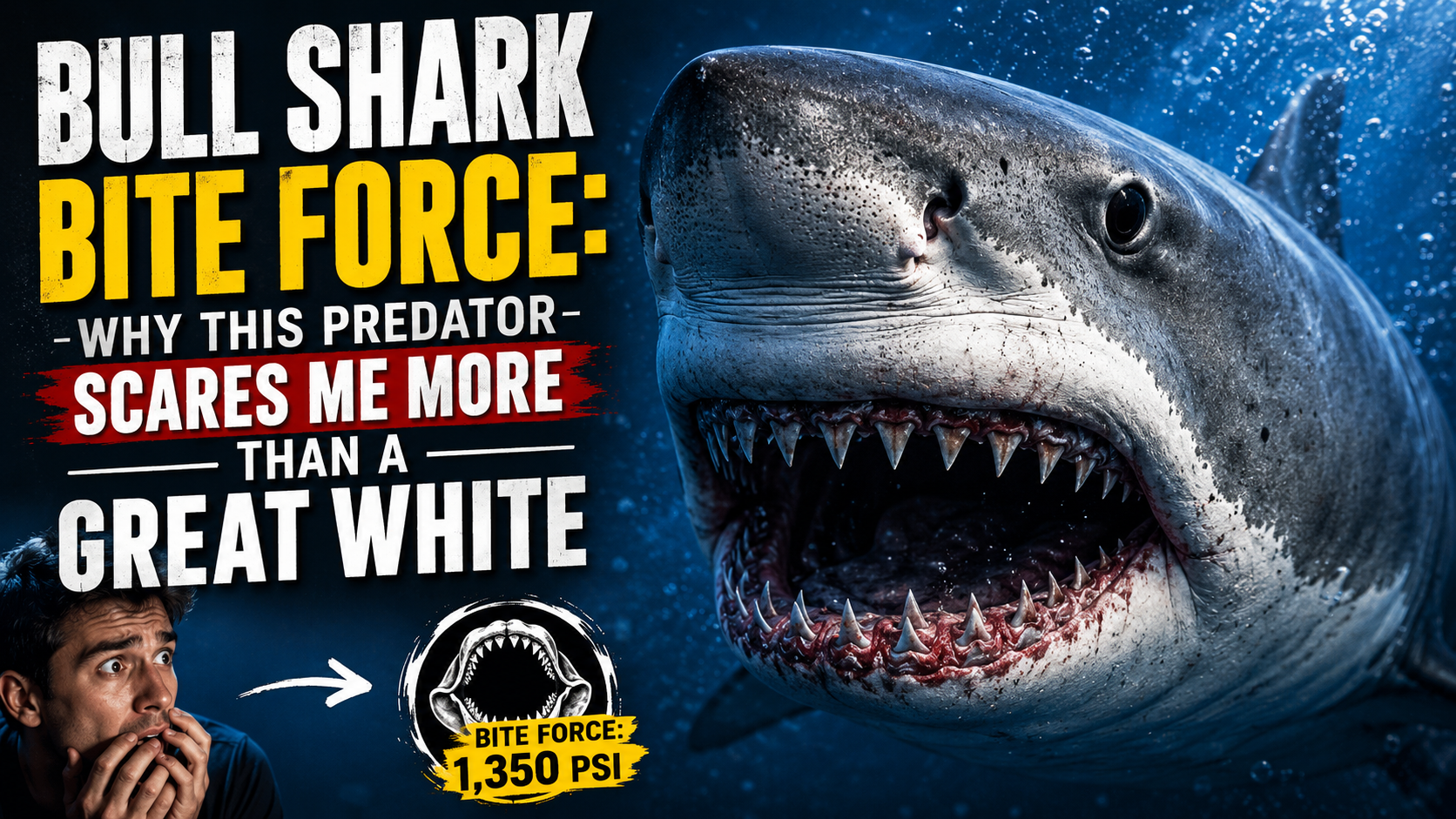
Bull Shark Bite Force: Why This Predator Scares Me More Than a Great White
I’ll admit something a little embarrassing. After I finished writing about the great white shark a few months ago, I genuinely thought I’d covered the scariest predator in the ocean. Case closed. I was wrong.
It happened while I was half-watching Shark Week previews and half-thinking about what to write next. One line stopped me mid-scroll: bull sharks are considered more dangerous to humans than great whites, not because they’re bigger or faster, but because of where they choose to live. Rivers. Lakes. The exact same murky, brown water I used to swim in as a kid without a second thought.
That sentence sent me down a research hole I didn’t climb out of for a week. I want to walk you through what I found, in the order I found it, because my opinion on which shark actually deserves the “most dangerous” title changed more than once along the way.
The Bite That Surprised Me
When I first looked up the numbers, I expected the great white to win, easily. It usually does in every “strongest bite” list I’d already put together for the jaguar piece and the crocodile piece.
Instead, I found this: pound for pound, the bull shark has the strongest bite of any shark in the ocean, great white included.
Its jaws clamp down at roughly 1,300 to 1,350 PSI (pounds per square inch). In lab measurements, researchers recorded a bite force close to 6,000 newtons, more than double the force needed to crack through bone.
To put that next to the numbers I’d already collected for other predators, here’s how it stacks up:
- Human bite force: ~150–200 PSI
- Dog bite force: ~300 PSI
- Hyena bite force: ~1,100 PSI
- Lion bite force: ~650 PSI
- Hippopotamus bite force: ~1,800 PSI
- Tiger bite force: ~1,050 PSI
- Jaguar bite force: ~1,500 PSI
- Bull shark bite force: ~1,300–1,350 PSI
- Great white shark bite force: commonly cited around 4,000 PSI, though real-world estimates vary depending on measurement method
Sure, the great white technically bites harder in raw numbers. But the great white is also close to three times the size of a bull shark. When I adjusted for body size, the way researchers actually do it, the bull shark comes out on top. It doesn’t need to be enormous to be devastating. It just needs to be built right, and it is.
That “pound for pound” detail is what hooked me. It’s the same story I told when I wrote about jaguars: size isn’t strength. Structure is.
Why the Bull Shark’s Address Is the Real Problem
Here’s the part that actually unsettled me more than any bite force number could.
Bull sharks aren’t ocean-only animals, unlike great whites and tiger sharks. They can survive in freshwater. They’ve been documented in rivers, lakes, and estuaries hundreds of miles from open sea. I read about bull sharks turning up in the Mississippi River, in Lake Nicaragua, and far up the Amazon basin.
That single fact rewired how I think about “shark territory.” I always pictured sharks as an ocean problem, something that stays past the waves, past the reef, somewhere I could reasonably avoid just by staying out of the sea. Bull sharks don’t respect that boundary. Their bodies can adjust to handle both salt and freshwater, which is rare among sharks, and it means they turn up in places people genuinely don’t expect to find one.
Murky river water. Warm, shallow lakes. Places where visibility is low and people swim, fish, and wade without a second thought. That overlap between bull shark habitat and everyday human activity is a big reason researchers rank them, alongside great whites and tiger sharks, among the three shark species most often involved in attacks on humans.
I used to think I was choosing safety by avoiding the open ocean and sticking to calmer inland water. Researching this piece, I learned that assumption doesn’t always hold up.
What Makes This Shark So Aggressive
Every source I read used some version of the same word: aggressive. Not “occasionally defensive.” Not “unpredictable.” Aggressive, as a defining trait.
Bull sharks are stocky, thick-bodied animals, growing up to around 13 feet and 700 pounds. They’re not built for speed like a mako or elegance like a great white cutting through open water. They’re built like a battering ram: low, wide, muscular, and short-tempered.
Part of that comes down to biology, though I want to be upfront here because I almost repeated a myth while writing this. Bull sharks have a popular reputation for having the highest testosterone of any animal on the planet, but that specific claim isn’t well supported by actual research — one University of Miami study even found lemon sharks testing higher. What does hold up is narrower but still telling: testosterone in male bull sharks rises during the summer breeding season, and that rise is linked to increased aggression and territoriality. They don’t cautiously scout an area and retreat if something seems off. They investigate by biting, and because they’re opportunistic apex predators, that “investigation” can be catastrophic for whatever’s on the other end of it.
Their diet reflects that same lack of pickiness. Bull sharks eat bony fish, smaller sharks, sea turtles, seabirds, and dolphins, pretty much anything they can physically overpower. I found that detail more telling than almost anything else in my research. This isn’t a specialist predator with a narrow diet and a narrow range. It’s a generalist that thrives by pushing into new territory and testing what works there.
When I compared that mindset to the jaguar’s hunting style, the difference was stark. Jaguars are precise and almost surgical, going straight for the skull in a single decisive bite. Bull sharks are the opposite: broad, forceful, and relentless. Two completely different survival strategies, both effective in their own unsettling way.
Bull Shark vs. Great White: The Comparison I Didn’t Expect
Going into this, I assumed the great white would win a head-to-head comparison by a wide margin. It doesn’t, not in every category.
Size: Great whites win, decisively. They can grow past 15 feet and weigh over 2,000 pounds, dwarfing a bull shark.
Raw bite force: Great whites again, at least according to the frequently cited 4,000 PSI figure.
Bite force relative to body size: Bull shark. Multiple sources I found agree it has the edge pound for pound.
Habitat flexibility: Bull shark, by a landslide. Great whites need saltwater to survive. Bull sharks don’t.
Odds of encountering a human: This is where it gets genuinely uncomfortable. Because bull sharks tolerate freshwater and shallow coastal zones, and because they’re territorial rather than avoidant, they end up in contact with humans more often than their public reputation suggests. Some researchers have even argued that a portion of historical shark attacks blamed on other species may actually have involved bull sharks, simply because bull sharks can appear in places a great white physically cannot reach.
I went into this comparison expecting a clear winner. I came out of it thinking the real question, “which is more dangerous,” depends entirely on where you happen to be standing at the time.
A Predator With a Long, Quiet History
Bull sharks don’t get the same cultural spotlight as great whites, but they’ve been swimming in and out of human contact for a long time. Coastal communities near river mouths and tropical lakes have dealt with bull shark encounters for generations, often without realizing which species was actually responsible. Because bull sharks can travel so far upstream, some historic freshwater attacks that were originally blamed on other animals, or written off as unexplained, have later been re-examined by researchers who suspect a bull shark was the more likely cause.
That quiet, under-the-radar history is part of what makes this shark so interesting to me. It’s not chasing headlines. It’s just persistently, patiently present in places we don’t think to look.
The Fear I Didn’t Expect to Feel
I’ve waded through rivers on trips across India without thinking twice. I’ve stood in warm, cloudy lake water up to my waist, more worried about leeches than anything else. Researching this piece changed that instinct, at least a little.
Bull sharks aren’t common everywhere, and I’m not writing this to make anyone afraid of every river or lake they encounter. Context matters. Most freshwater systems have zero bull shark presence, and most people who do share water with bull sharks never have an incident. Attacks are still rare, and sharks in general kill far fewer people each year than dogs, cows, or even vending machines, depending on which statistic you look at.
But there’s a difference between “rare” and “impossible,” and before this week, I had mentally filed bull sharks under “impossible, not my problem.” Now I know better. In parts of the world where rivers meet the sea, in certain lakes fed by tidal estuaries, in specific stretches of coastline where the water goes from clear to brown within a few steps, the “not my problem” assumption doesn’t hold up.
Why This Predator Deserves More Attention Than It Gets
Great whites get the movies. They get the week-long TV specials, the ominous music, the fin-above-the-water shot that’s become shorthand for danger. Bull sharks get comparatively little of that, despite arguably deserving just as much caution, maybe more, given how often their range overlaps with places people actually spend time.
I think that mismatch says something about how we process fear. We’re drawn to the dramatic, cinematic version of danger: the open-ocean predator with a body built like a torpedo. We’re much less tuned in to the quieter, closer threat, the one that might be a few feet away in water we assumed was safe simply because it wasn’t the ocean.
Researching bull sharks didn’t just teach me a new bite force number to file away next to jaguars and hyenas. It changed the category of animal I think about when someone says “dangerous predator.” It’s not always the biggest one. It’s not always the one with the scariest silhouette. Sometimes it’s the one that’s adapted to be everywhere, comfortable in water most predators can’t tolerate, aggressive by default, and built, pound for pound, to hit harder than almost anything else in the sea.
Quick Answers, In Case You’re Skimming
I know not everyone reads a piece like this top to bottom, so here’s the short version of what I learned:
Is a bull shark’s bite stronger than a great white’s? Not in raw numbers. But relative to body size, researchers consider the bull shark’s bite the strongest of any shark, great white included.
Can bull sharks really live in freshwater? Yes, permanently if needed. They’ve been recorded far upstream in rivers and in landlocked lakes, which is unusual for a shark species.
Are bull sharks more dangerous than great whites? It depends on location. Bull sharks are involved in a disproportionate number of attacks precisely because they turn up in shallow, murky, freshwater areas where people don’t expect sharks at all.
What is a bull shark’s bite force in PSI? Approximately 1,300 to 1,350 PSI, based on the studies I found.
A Few Things I’m Actually Doing Differently Now
I’m not about to swear off rivers and lakes for the rest of my life, and I don’t think that’s the right takeaway here. But researching this did change a few small habits.
I check what’s actually in the water before I wade in anywhere new, especially in tropical river mouths, estuaries, or lakes connected to the sea, the exact conditions bull sharks favor. I’m more cautious around dawn and dusk, when a lot of shark activity, bull sharks included, tends to pick up. And I’ve stopped assuming “freshwater” automatically means “shark-free,” which is a bigger mental shift than it sounds like on paper.
For anyone who wants the real numbers instead of my paraphrasing, the International Shark Attack File at the Florida Museum tracks confirmed incidents by species and location every year, and it’s the source most of the researchers I read kept citing. It’s a sobering read, but it’s also the best antidote to both overreacting and underreacting to a genuinely rare risk.
What I’m Taking Away From This
If there’s one thing this research reinforced for me, it’s a pattern I keep running into every time I dig into a new predator for this blog: the animals that impress me most are rarely the biggest ones. They’re the ones built with purpose, whether that’s a jaguar’s compact skull, a crocodile’s ambush patience, or a bull shark’s ability to thrive in water that should, by all logic, keep it out.
I don’t think I’ll ever look at a murky river the same way again. Not with panic, just with a little more respect for what might be sharing the water with me.
And with Shark Week just around the corner, I have a feeling I’m not done falling down this particular rabbit hole.
Read more like this
Discover more from Bhuchi's World
Subscribe to get the latest posts sent to your email.

Bhushana Paluru is the founder of Bhuchi’s World, a travel and culture blog that explores spiritual destinations, history, and unique experiences. Passionate about storytelling and exploration, Bhushana shares insightful guides and inspiring narratives that connect readers with the deeper meaning behind places and journeys.