India’s Gig Worker Strike: What the New Year Shutdown Reveals About App-Based Delivery
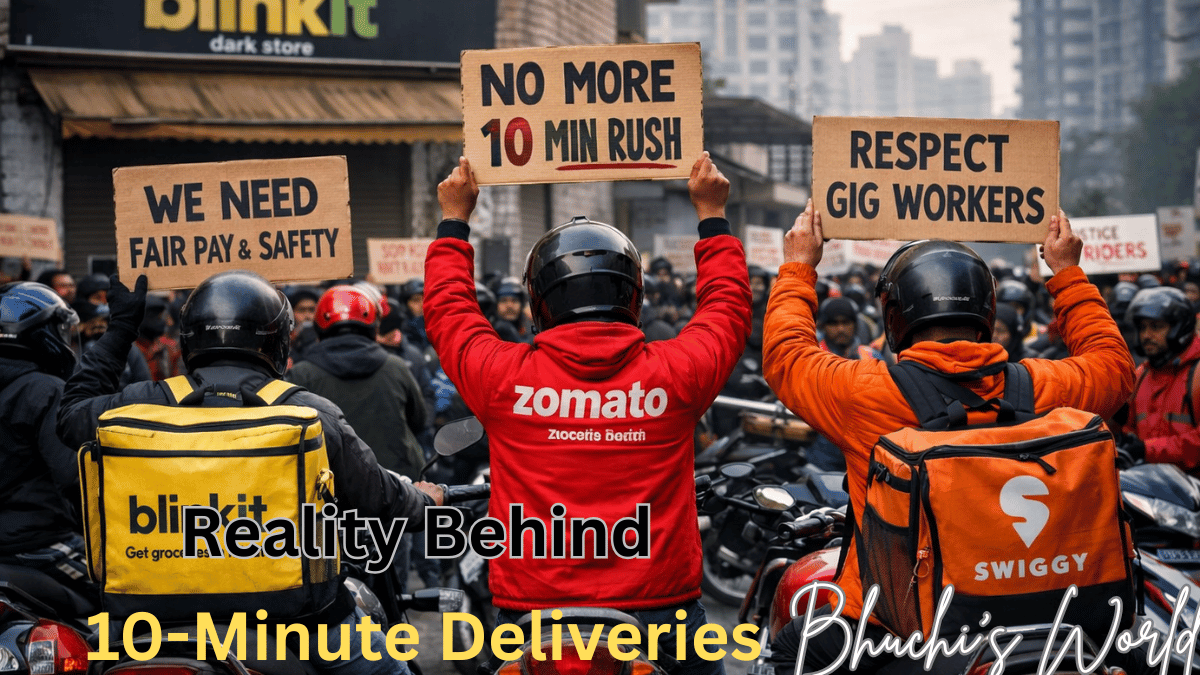
As India celebrated New Year’s Eve, thousands of app-based delivery workers quietly shut down their apps, parked their bikes, and walked off the algorithm. Riders and delivery partners for platforms like Zomato, Blinkit, Swiggy, Zepto, and others organised a coordinated strike across major metros, directly challenging the 10‑minute delivery model that had been sold as the future of Indian convenience.
The images were stark: busy food and grocery apps showing longer delivery times, dark‑store hubs surrounded by protesting riders, and social media feeds filled with helmet‑clad workers explaining why your biryani and groceries might not arrive on time. The strike marked a tipping point in a tension that had been building for years between platforms promising speed and customers demanding discounts, all resting on precarious, under‑protected labour.
Why gig workers are striking in India
Shrinking earnings and rising costs: Riders say per‑order payouts have fallen over time, while fuel, vehicle maintenance, and living costs have climbed, forcing them to work longer hours to earn what used to be a day’s income. Many demand a dignified monthly earning, often around ₹40,000, backed by transparent incentives rather than constantly shifting promotions.
- Unsafe ultra‑fast delivery targets: The 10‑minute and other ultra‑fast promises are a core flashpoint, with riders describing constant pressure to beat timers, navigate traffic aggressively, and work through rain or extreme heat to avoid penalties and bad ratings. Behind every “Delivered in 9 mins” notification sit incentives that reward risk‑taking and algorithms that punish delays, even when caused by traffic or restaurant issues.
- Algorithmic control and fear of deactivation: Workers regularly report sudden ID blocks, deactivations, and changes in payout structures with little warning or explanation, driven by opaque algorithms and automated risk flags. For many, a deactivation means instant loss of their main income, with no due process or meaningful appeal.
The strike is therefore not just about money per order; it is about dignity, safety, and the basic right to know how one’s work is being measured and punished.

Platforms, politics, and public narrative in India
Platform companies have tried to balance reassurance to customers with public defence of their business models.
On New Year’s Eve, Zomato and Blinkit highlighted record order volumes and claimed that operations remained robust, suggesting the strike did not significantly disrupt business—an assertion gig unions quickly dismissed as misleading and disrespectful. Unions argued that such statements were an attempt to undercut workers’ collective bargaining power and discourage others from joining.
Zomato CEO Deepinder Goyal went further, publicly stating that if the system were fundamentally unfair, workers would not stay on the platform, while responding to criticism that 10‑minute delivery is inherently unsafe. His comments sparked a broader online debate about whether gig work is genuinely “flexible entrepreneurship” or “disguised employment” without safety nets.
Politicians have begun to choose sides. AAP leader Raghav Chadha described gig workers as “hostages with helmets, criticising platforms for labelling protesting riders as miscreants instead of recognising them as workers asserting rights. This language resonated because it captured the sense that riders are trapped between customer expectations, platform algorithms, and a legal vacuum that does not fully see them as employees or as fully independent businesses.
India’s policy framework: recognition without teeth
On paper, India appears progressive compared to many countries, as it explicitly names gig workers in its national law. Yet in practice, the gap between recognition and protection remains wide.
- Code on Social Security, 2020: This law recognises “gig workers” and “platform workers” as distinct categories and envisages schemes for life and disability cover, accident insurance, and other social security benefits. However, the code’s full implementation has been slow, and many schemes either remain at the design stage or cover only small subsets of workers.
- State-level experiments: Rajasthan has enacted a law to establish a welfare board for gig workers and to impose a small fee on each online transaction to fund social security, but similar structures are still rare in other states. This means a rider’s level of protection can depend heavily on where they work and which state government chooses to move first.
- No hard floors on pay or hours: Unlike traditional employees, gig workers are not covered by clear statutory minimum wages, standard working hours, paid leave, or overtime rules, leaving earnings largely at the mercy of platform algorithms and demand cycles.
India’s current framework, therefore, offers a kind of symbolic recognition: gig workers exist in the law, but the enforceable rights that would meaningfully change their daily lives are still under construction.
Looking outward: how other countries regulate gig work
To understand where India stands, it helps to compare its approach with other major markets where gig work has become central to urban life.
Spain: presumption of employment
Spain is often cited as the most aggressive regulator of food‑delivery platforms. After years of court battles in which riders argued they were misclassified, Spain passed the “Rider Law” in 2021.
The law creates a presumption that food‑delivery riders are employees, not freelancers, which means they must receive minimum wages, paid leave, social‑security contributions, and protection against unfair dismissal.
- It also requires platforms to provide worker representatives with information about algorithms that affect working conditions, pushing for more transparency in how orders are assigned and performance is evaluated.
While enforcement has been uneven and some platforms have tried to adapt through subcontracting, the legal direction is clear: riders are workers first, “entrepreneurs” second.
France: a contested middle path
France’s experience is more complex, reflecting both a strong welfare state and intense platform lobbying.
- French courts have issued mixed rulings: some cases have upheld riders’ independent‑contractor status, while others have reclassified them as employees and punished platforms like Deliveroo for misclassification.
- The government has experimented with a hybrid model: enabling platform‑worker representation and social dialogue, and agreeing on a minimum hourly pay for delivery riders (around €11.75 per hour in 2023) along with rules on account deactivation.
Yet researchers note that many riders—especially migrants and undocumented workers—still face precarious conditions and knowledge gaps about their rights, reminding us that legal frameworks are only as strong as their enforcement on the ground.
Indonesia: protest-driven incremental gains
Indonesia offers a glimpse of how large emerging economies try to balance platform growth with social stability.
- Millions of drivers for Gojek, Grab and other platforms have held protests over low fares, commission cuts, and arbitrary algorithmic changes, echoing many of the grievances heard in India.
- Authorities have responded with measures such as caps on platform commissions (often around 20%), mandated holiday bonuses for drivers (like pre‑Eid payments), and promises to improve regulations on tariffs and social protection.
Indonesia still lacks a single, comprehensive law redefining gig workers’ status, but repeated protests have forced both platforms and regulators to accept that driver welfare is now a political issue, not just a business variable.
6The US model: patchwork protections and political battles
The United States provides another instructive comparison because, like India, it combines rapid platform growth with a fragmented regulatory landscape.
Federal tug‑of‑war
At the federal level, the key question is whether gig workers should be treated as “employees” or “independent contractors” under laws like the Fair Labour Standards Act.
- In early 2024, the US Department of Labour issued a rule tightening the test for independent‑contractor classification, placing more emphasis on factors like control and economic dependence, which could make it easier to argue that many gig workers are employees.
- However, in 2025 the Department announced it would not enforce that rule, creating uncertainty and leaving much of the practical fight over status to state laws and private litigation.
This federal ambivalence mirrors India’s: recognition of the problem, but hesitance to impose a sweeping, nationwide solution.
California’s Prop 22 compromise
California has been the highest‑profile battleground.
- Assembly Bill 5 (AB5) introduced the strict “ABC test” for employment, making it hard for companies to treat gig workers as independent contractors.
- In response, companies like Uber, Lyft and DoorDash backed Proposition 22, a ballot measure that carved out app-based rideshare and delivery drivers from AB5 and classified them as independent contractors with a limited package of benefits.
Prop 22, upheld by the California Supreme Court in 2024, offers drivers minimum earnings during engaged time, a health-care stipend for high‑hour drivers, and accident insurance, but it does not provide full employee benefits such as unemployment insurance or collective bargaining rights. Many worker advocates see it as a “third category” that locks in contractor status while offering just enough benefits to quell some criticism.
City-level protections: New York and Seattle
US cities have also become laboratories for gig‑work policy, especially for delivery workers.
New York City has introduced minimum pay standards for app-based delivery workers, with rates set to exceed 21 dollars per hour of active time from April 2025, along with rules on tip transparency and bathroom access at partner restaurants.
- Seattle has adopted a “Pay Up” package and specific app-based worker ordinances that guarantee minimum pay, paid sick leave, dispute‑resolution processes, and protections against sudden or automated deactivation without notice.
These city-level laws show that even where the default classification remains “independent contractor”, governments can still regulate earnings floors, transparency and platform behaviour.
India vs USA: where they converge and diverge
Comparing India and the USA reveals both similarities and sharp differences.
- Similarities: In both countries, most gig workers are still treated as independent contractors, and there is no single, nationwide law that clearly reclassifies platform workers as employees. Policy change is driven by fragmented efforts—state laws in India, state and city ordinances in the US, plus court cases and ballot measures.
- US advantage in concrete protections: Even while preserving contractor status, US jurisdictions like New York City and Seattle have implemented legally enforceable minimum pay standards, sick leave, and deactivation protections, something India has not yet rolled out at scale. By contrast, Indian riders’ earnings, working hours and risk levels are still largely governed by platform algorithms and market conditions.
- India’s symbolic lead: India’s national social security code explicitly recognises gig workers and creates a framework for future schemes, whereas the US lacks an equivalent, dedicated nationwide social‑security law for platform workers. However, until India funds and implements these schemes at scale, workers will experience this advantage more on paper than in their daily lives.
In short, India has taken rhetorical and legal recognition steps at the national level, while the US has produced more concrete pay and protection rules in specific cities and states; neither country has yet delivered a fully coherent, worker‑centred model.
Comparison table
| Country / Jurisdiction | Main legal status of delivery gig workers | Key gig‑specific laws / rules | Social security / employer contribution | Minimum pay / wage benchmark for delivery workers | |
|---|---|---|---|---|---|
| India (national) | Recognised in law as gig / platform workers, but usually treated as independent contractors in practice. | Code on Social Security, 2020 includes gig and platform workers in social security framework; separate Code on Wages applies broadly but no specific gig‑only wage floor yet. | Aggregator platforms must contribute 1–2% of annual turnover (capped at 5% of payouts to workers) into a Social Security Fund for gig/platform workers, but schemes and coverage are still being rolled out. | No dedicated nationwide minimum hourly rate for delivery workers; earnings depend on platform algorithms, incentives and local demand, with unions demanding “dignified” monthly incomes (often around ₹40,000). | |
| Spain (national) | Food‑delivery riders presumed to be employees of platforms under the “Rider Law”. | “Ley Rider” (Rider Law) embeds Supreme Court rulings that platform riders are employees; general labour law and collective agreements apply. | Platforms must pay full social‑security contributions (towards pensions, healthcare, unemployment, etc.) as for other employees. | Riders are covered by Spain’s general minimum wage and sector agreements; studies note typical gross annual labour earnings around the national minimum (about €14,700–€15,900 in recent years). | |
| USA – NYC (city level) | App‑based delivery workers treated as independent contractors, but with city‑mandated pay floor. | NYC minimum pay rule for app‑based restaurant delivery workers under local consumer and worker‑protection laws. | No full employee‑style social security from platforms; however, higher mandated pay is meant to help cover lack of traditional benefits and work expenses. | From 1 April 2025, platforms must pay at least $21.44 per hour before tips (up from earlier phases starting near $18), indexed to inflation. | |
| USA – general federal picture | Most gig drivers / couriers are still independent contractors under federal and most state laws. | 2024 US Department of Labor rule tightened the test for who counts as an independent contractor under the Fair Labor Standards Act, but DOL later announced it would not enforce that rule, leaving classification mostly to courts and states. | No federal requirement for platforms to pay social‑security contributions like regular employers; workers pay self‑employment taxes and often lack unemployment insurance or employer‑provided benefits. | No federal minimum wage rule specifically for gig delivery workers; standard federal minimum wage applies only where workers are classified as “employees”, which most gig workers are not. |
Possible paths forward for India
The current strike gives India an opportunity to move from broad promises to specific, enforceable protections.
Drawing from both European and US experiments, Indian policymakers and platforms could consider:
- Adopting a rebuttable presumption of employment in high‑control segments like food and quick‑commerce delivery, similar to Spain’s Rider Law, while allowing genuine independent contractors to prove self‑employment where appropriate.
- Setting minimum earning standards for active platform time, inspired by New York and Seattle, to ensure riders are not paid below a city‑specific living threshold after costs.
- Codifying deactivation and algorithmic transparency rules, including advance notice, clear reasons, human review, and a right to challenge automated decisions, as seen in Seattle and in parts of the EU debate.
- Operationally rethinking ultra‑fast delivery, where platforms voluntarily relax 10‑minute promises or adjust payout structures so that safety and reasonable speeds are rewarded rather than penalised.
For platforms, embracing these changes is not just a cost; it is a reputational hedge and a way to stabilise their workforce in a market where demand is still growing rapidly. For policymakers, the strike is a clear warning: ignoring gig workers’ demands today risks larger economic and political disruptions tomorrow, as this workforce continues to expand.
Read More On : Bhuchisworld
Discover more from Bhuchi's World
Subscribe to get the latest posts sent to your email.










Post Comment