
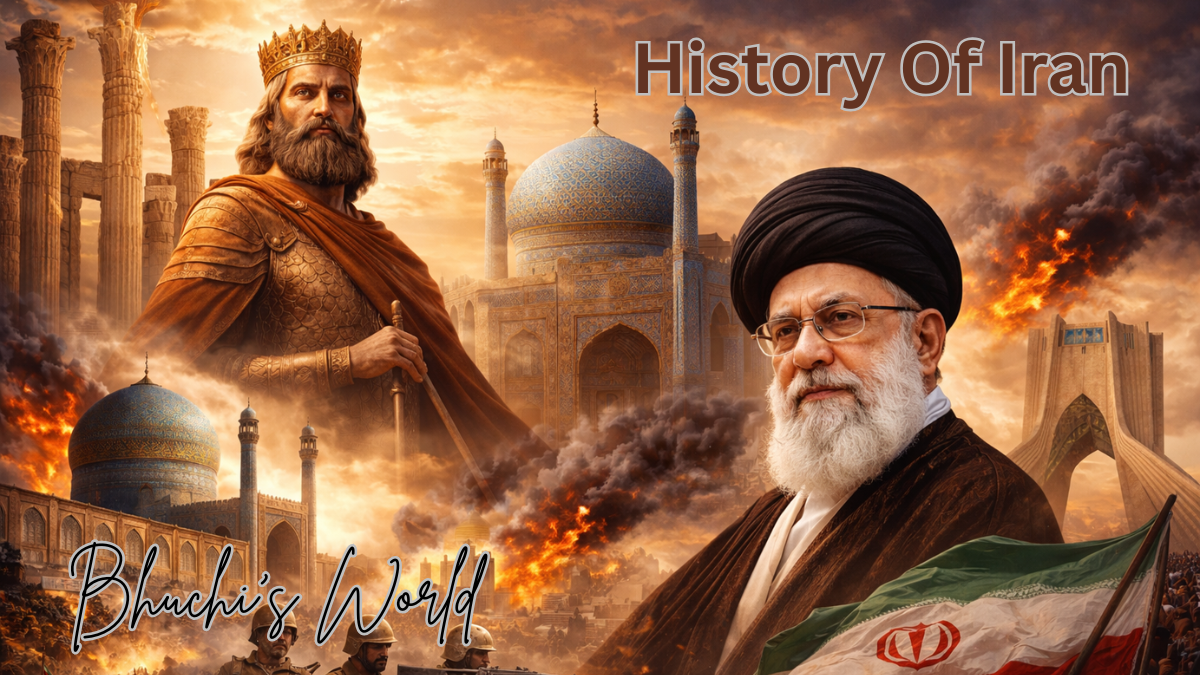
A Historic Morning: March 1, 2026
On 1 March 2026, Iran woke up to news that instantly became part of its long and layered history. State media confirmed the death of Ali Khamenei, the country’s Supreme Leader for nearly four decades. He was not simply a political figure. He was the highest religious and constitutional authority in the Islamic Republic. For 37 years, presidents changed, policies evolved, and global tensions rose and fell—but he remained.
His passing felt larger than a headline. For many Iranians, it marked the closing of a chapter that began in 1989, after the death of Ruhollah Khomeini, the revolutionary cleric who founded the Islamic Republic. But to understand why this moment carries such weight, you have to step back—far beyond modern politics, beyond 1979, and even beyond Islam itself.
Iran’s story did not begin with a revolution. It did not begin with a monarchy. It began thousands of years earlier.
A Civilization Older Than Most Nations
When people ask, “How old is Iran?” the answer depends on what you mean by age.
As an imperial power, Iran traces its history to 550 BCE, when Cyrus the Great founded the Achaemenid Empire. That empire became one of the largest the ancient world had ever seen, stretching from parts of India to the Mediterranean.
But organized civilization existed on this land even earlier. The ancient civilization of Elam dates back to around 2700 BCE. Archaeological discoveries show cities, trade networks, writing systems, and structured governance more than 4,000 years ago.
That kind of continuity is rare.
Empires collapsed here. Religions shifted. Foreign armies invaded. Political systems transformed. Yet the Persian language, memory, and identity survived. Even the country’s name reflects this depth. For centuries, much of the world called it Persia, derived from the region of Fars. In 1935, the government formally requested the international community use the name Iran, rooted in an ancient term meaning “Land of the Aryans.”
Names changed. Borders changed. But the civilization endured.
The Rise of Ancient Persia
Before Islam, Iran stood at the center of powerful empires and spiritual traditions. Under Cyrus the Great, the Achaemenid Empire built a governance system that was extraordinary for its time. Instead of forcing cultural uniformity, Persian rulers often allowed conquered peoples to maintain their religions and customs. This approach created stability across a vast and diverse territory.
Even when Alexander the Great conquered Persia in 330 BCE, Persian civilization did not disappear. It absorbed influence, adapted, and reemerged.
Later, the Parthian Empire rose as a rival to Rome. After them came the Sasanian Empire, often considered the height of pre-Islamic Persian civilization. Trade flourished along the Silk Road. Art and architecture expanded. State authority strengthened. Persian identity became more defined and confident.
Zoroastrianism: Faith Before Islam
Before Islam, the dominant religion in Iran was Zoroastrianism, founded by the prophet Zarathustra. It centered on the worship of Ahura Mazda, the god of truth and light, and emphasized the moral struggle between good and evil.
The teachings stressed personal responsibility—choosing truth over falsehood, righteousness over corruption. Under the Sasanian Empire, Zoroastrianism became the state religion. Spiritual authority and political power were deeply connected.
This relationship between faith and governance would echo centuries later in a different form.
The Arrival of Islam and Cultural Survival
In 651 CE, Arab Muslim forces defeated the Sasanian Empire. Islam gradually spread across Iran. But something remarkable happened during this transformation.
While religion changed, Persian culture endured.
Iranian scholars, poets, administrators, and thinkers became central contributors to the Islamic Golden Age. The Persian language reemerged as a powerful literary and intellectual force. Iran did not dissolve into a new identity — it reshaped the Islamic world from within.
This pattern of adaptation without erasure became a defining trait of Iranian history.
The Safavid Turning Point
In 1501, the Safavid dynasty declared Twelver Shi’a Islam the official religion of Iran. This decision permanently distinguished Iran from many of its predominantly Sunni neighbors.
This was not just a theological shift. It reshaped political identity and national consciousness. Shi’a Islam emphasized the authority of the Imams, the idea of martyrdom, and the importance of religious scholarship. These ideas would later influence the structure of modern Iranian governance.
The Safavid decision still shapes Iran’s identity today.
War, Destruction, and Renewal
Throughout its long history, war has repeatedly reshaped Iran.
The Mongol invasions in the 13th century brought massive destruction. Cities were devastated. Populations suffered immense loss. Yet even after such a catastrophe, Persian culture revived. Mongol rulers eventually adopted aspects of Persian administration and Islam.
Centuries later, from 1980 to 1988, the Iran–Iraq War became one of the most defining conflicts in modern Iranian memory. Only one year after the 1979 Revolution, Iraq invaded Iran. The war lasted eight brutal years and caused enormous human and economic loss.
For many Iranian families, this war is not distant history. It lives in memory—in stories told at dinner tables, in photographs, and in graves visited quietly. It reinforced themes of sacrifice, resistance, and national defense that still influence political identity today.
From Monarchy to Revolution
The twentieth century brought rapid and dramatic transformation.
The Constitutional Revolution of 1905–1911 introduced parliament and attempted to limit royal authority. It was an early step toward reform. In 1925, Reza Shah Pahlavi established the Pahlavi dynasty and pursued modernization and centralization. His son, Mohammad Reza Shah Pahlavi, expanded industrialization and strengthened Western alliances. Oil wealth fueled economic growth. Cities modernized. Infrastructure expanded.
But modernization came with political repression. Many citizens and religious leaders felt alienated from the monarchy. Opposition steadily grew through the 1960s and 1970s.
By 1979, mass protests reshaped the country.
Ruhollah Khomeini returned from exile. The monarchy ended. Iran became an Islamic Republic. The new system combined elected institutions—a president and parliament—with religious oversight under a Supreme Leader. Religion was no longer simply cultural or spiritual. It became constitutionally embedded in governance.
The Khamenei Era: 1989–2026
When Khomeini died in 1989, Ali Khamenei became Supreme Leader. His leadership defined modern Iran for 37 years.
The Supreme Leader holds authority over the armed forces, judiciary, state broadcasting, major appointments, and overall direction of foreign policy. While presidents changed, the ultimate authority remained in his office.
During his tenure, Iran expanded regional alliances, navigated nuclear negotiations, faced international sanctions, and managed domestic unrest. Supporters saw his stance as defending sovereignty and resisting foreign pressure. Critics viewed it as contributing to economic hardship and international isolation.
Regardless of perspective, his era shaped the Iran the world knows today.
His death in 2026 marked another transition in a civilization that has experienced many.
Religion and Modern Identity
Religion has never been separate from Iran’s political story. From Zoroastrian fire temples to Shi’a scholarship to the constitutional structure of the Islamic Republic, faith has consistently shaped authority.
Yet Iran today is complex and diverse. Alongside the Shi’a majority live Sunni minorities, Christians, Jews, Zoroastrians, and secular citizens. Society continues to evolve. Younger generations navigate tradition and modernity simultaneously.
The balance between faith, reform, and governance remains an ongoing conversation within the country.
A Story That Continues
Iran’s history is not a straight line. It is layered and cyclical. It is a story of empire and invasion, faith and reform, revolution and reconstruction.
From Cyrus the Great to the Safavid kings, from the Pahlavi monarchy to Khomeini’s revolution, from Khamenei’s long leadership to whatever comes next—each era reshapes the next chapter.
If history offers one consistent lesson, it is this:
Iran does not disappear.
It transforms.
It adapts.
It endures.
And its story is still being written.
Discover more from Bhuchi's World
Subscribe to get the latest posts sent to your email.