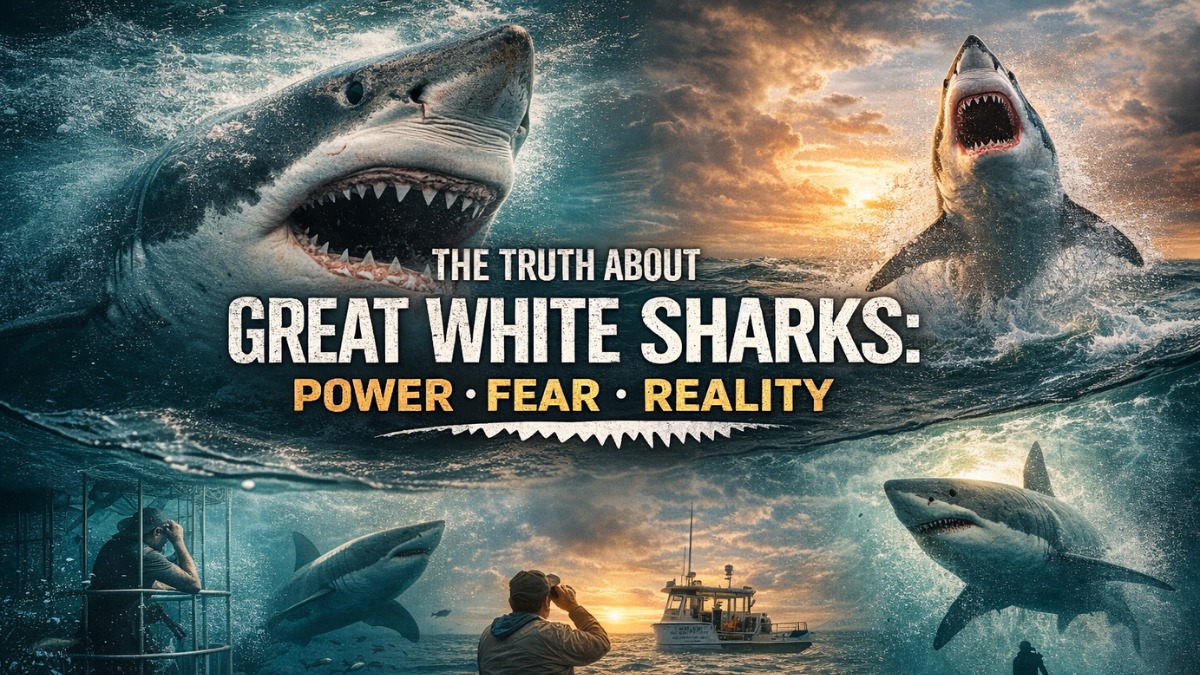
Great White Shark – The Ocean’s Most Misunderstood Predator
There’s something about the great white shark that instantly grabs your attention. Maybe it’s the size. Maybe it’s the reputation. Or maybe it’s the mystery that surrounds it.
You’ve probably seen it in movies — powerful, aggressive, unstoppable. But here’s the truth that often gets missed: the real great white shark is far more fascinating than the version we’ve been shown.
Imagine floating in the open ocean. Beneath you, in the deep blue silence, something massive moves — not loudly, not chaotically, but with calm precision. That’s the great white shark. It doesn’t rush. It doesn’t panic. It observes.
This predator has existed for millions of years, evolving into one of the most efficient hunters in the animal kingdom. Every part of its body, from its sharp teeth to its streamlined shape, is designed for survival.
And yet, despite all this power, it remains one of the most misunderstood creatures on Earth.
In this article, you’re not just going to learn facts. You’re going to see the great white shark differently — from its incredible size and speed to its terrifying bite force and surprisingly misunderstood behavior.
Great White Shark Facts That Might Change How You See Them
At first glance, the great white shark seems simple — a big predator with sharp teeth. But the deeper you look, the more surprising it becomes.
For example, did you know a great white shark can sense tiny electrical signals in the water? This ability allows it to detect hidden prey, even if it’s buried beneath sand. It’s like having a built-in radar system.
Another detail most people don’t realize is how often they lose their teeth. Thousands of teeth fall out and are replaced throughout their lifetime. So when you see those rows of razor-sharp teeth, you’re actually looking at a constantly renewing weapon.
And then there’s breaching — one of the most breathtaking sights in the ocean. A massive shark launching its entire body out of the water to catch prey. It’s not just power — it’s perfect timing and precision.
But perhaps the most surprising fact is this: great white sharks are partially warm-blooded. This gives them an advantage in colder waters, allowing them to move faster and hunt more effectively than many other fish.
When you connect all these traits together, you start to see why they dominate their environment. They’re not just strong — they’re incredibly well-adapted.
How Big Is a Great White Shark? The Size That Changes Everything
It’s one thing to hear numbers. It’s another to actually imagine them.
A fully grown great white shark can reach lengths of over 20 feet. That’s longer than most cars. Now picture that moving silently beneath the surface — not making noise, not creating chaos, just gliding.
Their weight can exceed 2,000 pounds, yet they don’t move like something heavy. Instead, they move with surprising smoothness, almost like they’re floating effortlessly.
What makes it even more interesting is that females are usually larger than males. This size difference plays a role in reproduction and survival, making females even more dominant in certain situations.
But here’s where it really becomes fascinating: their size isn’t just about intimidation. It’s about efficiency. A larger body allows them to travel long distances, store energy, and take down bigger prey.
And when you finally understand their size in context, you realize something — they’re not just big fish.
They’re perfectly engineered predators.
Great White Shark Habitat – Where Silence Meets Power
If you’re expecting great white sharks to stay in one place, you might be surprised.
These sharks are travelers. Not short-distance swimmers, but ocean-crossing navigators. They move across thousands of kilometers, following food, temperature changes, and seasonal patterns.
You’ll often find them in coastal regions like South Africa, Australia, and California — places where seal populations are high. But they don’t stay there forever. They disappear into deeper waters, sometimes for months, and scientists are still trying to fully understand why.
Their preferred environment is cooler water, but thanks to their unique ability to regulate body temperature, they can survive in conditions that many other fish cannot.
What makes their habitat even more fascinating is how invisible they are within it. The dark top of their body blends with the ocean depths, while the lighter underside matches the sunlight from above.
This natural camouflage makes them almost impossible to detect — until it’s too late for their prey.
What Do Great White Sharks Eat? A Diet Built on Precision
The diet of a great white shark isn’t random — it evolves as the shark grows.
When they’re young, they feed mostly on smaller fish and marine animals. At this stage, they’re still learning, still developing their hunting techniques.
But as they grow, their diet shifts dramatically.
Adult great white sharks prefer high-fat prey like seals and sea lions. These animals provide the energy needed to sustain such a large predator. And here’s where things get intense — their hunting strategy is all about surprise.
They don’t chase endlessly. Instead, they approach from below, using speed and timing to deliver a single, powerful strike.
That strike is often enough.
And if you think about it, this method is incredibly efficient. It minimizes energy use while maximizing success. In the wild, that balance is everything.
Great White Shark Speed – The Power You Don’t See Coming
At first, you might assume a creature this large would be slow. But that assumption couldn’t be more wrong.
Great white sharks can reach speeds of up to 40 km/h — but what makes them truly dangerous isn’t just speed. It’s how they use it.
Most of the time, they move slowly, conserving energy. But when the moment comes, they accelerate with explosive force.
This sudden burst allows them to catch prey off guard. There’s no warning. No gradual build-up. Just instant power.
And when combined with their size and strength, this speed becomes one of their most effective tools.
The Bite Force That Places Them Among the Strongest in the Animal Kingdom
If there’s one feature that truly defines the great white shark, it’s the bite.
With an estimated force of up to 18,000 Newtons, their bite ranks among the most powerful in the animal kingdom. This isn’t just strength — it’s precision combined with raw force.
Their teeth are designed to tear, not just cut. Serrated edges allow them to slice through flesh and bone with minimal effort.
When you explore animals bite force, very few creatures come close to this level of power. It’s what allows them to take down large prey and maintain their position at the top of the food chain.
But what’s interesting is that they don’t always use their full strength. Much like their speed, their bite is controlled, used only when necessary.
Great White Shark Attacks – The Reality Behind the Fear
The word “attack” creates an image of aggression. But in reality, most shark encounters are far less dramatic.
Great white sharks don’t hunt humans. In fact, humans are not part of their natural diet.
Most incidents occur because of mistaken identity. From below, a swimmer or surfer can resemble a seal. The shark investigates with a bite — not to attack, but to understand.
And in many cases, that single bite is where the interaction ends.
Understanding this doesn’t remove the danger, but it changes the perspective. It shifts the story from fear to awareness.
Why Great White Sharks Attack Humans – A Simple Truth
The real reason is surprisingly simple: confusion.
Sharks rely heavily on vision and movement patterns. When something behaves like prey, they respond accordingly.
But once they realize the mistake, they often retreat.
This behavior highlights something important — they are not mindless predators. They are intelligent animals making decisions based on limited information.
Great White Shark Population – A Predator That Needs Protection
Despite their power, great white sharks are not invincible.
Their population is declining due to human activities like overfishing and accidental capture. Combined with slow reproduction rates, this makes recovery difficult.
They are currently classified as vulnerable, which means they need protection to survive long-term.
And this creates an important realization: even the ocean’s top predator depends on balance.
Final Thoughts – Looking Beyond the Fear
When you look at the great white shark closely, the fear starts to fade — and curiosity takes its place.
You begin to see not just a predator, but a perfectly adapted creature playing a crucial role in the ocean’s ecosystem.
If you enjoy exploring deeper truths about the animal kingdom and discovering powerful insights like animals bite force, you’ll find more engaging content on bhuchisworld — where complex ideas are made simple, and curiosity always leads the way.
Discover more from Bhuchi's World
Subscribe to get the latest posts sent to your email.








Post Comment