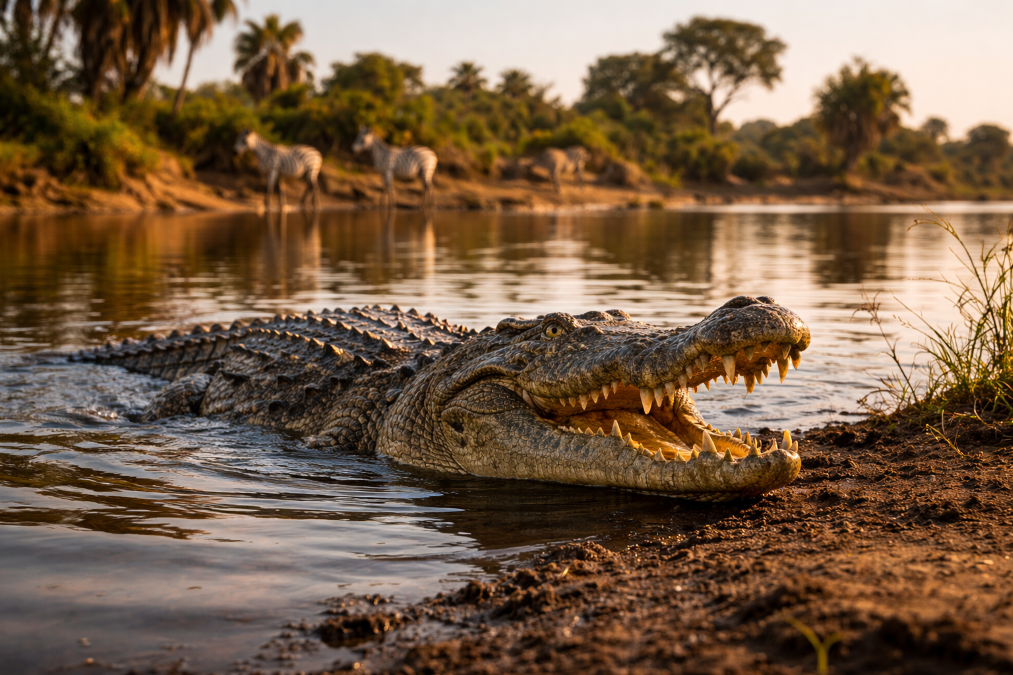
How Dangerous Is the Nile Crocodile? The Silent Predator of African Waters
The water looks calm. A quiet riverbank under the African sun. Birds chirp, and the surface barely moves. But beneath that stillness lies one of the most feared predators on Earth. If you’ve ever wondered how dangerous is the Nile crocodile, the answer isn’t simple—it’s chilling.
This reptile doesn’t chase loudly or roar before it attacks. It waits. It watches. And when the moment is right, it strikes with explosive force. For centuries, people living near rivers and lakes in Africa have respected—and feared—this animal for good reason.
Unlike many predators, it doesn’t rely on speed over long distances or visible intimidation. Its power lies in patience, precision, and raw strength. And that’s exactly what makes it so dangerous.
How Dangerous Is the Nile Crocodile? Understanding Its True Nature
To truly understand the danger, you have to look beyond fear and into reality. This reptile is not aggressive without reason—it is simply built to survive in one of the toughest ecosystems on the planet.
On average, these predators are responsible for hundreds of human deaths every year, making them one of the deadliest animals in the world. Unlike sharks, which are often misunderstood, these reptiles live close to human settlements. People depend on the same water sources for fishing, washing, and drinking. That overlap creates frequent encounters.
What makes them especially dangerous is their unpredictability. There’s no warning growl, no visible threat. One moment, the water is still. The next, it explodes.
They are also incredibly territorial. If you unknowingly enter their space—especially during breeding season—you’re already at risk. And once they decide to attack, there is very little chance of escape.
Yet, it’s important to understand: they are not “man-eaters” by nature. Humans are not their preferred prey. Most attacks happen due to opportunity, territory defense, or mistaken identity.
Still, the danger is very real—and deeply rooted in how they live and hunt.
How Dangerous Is the Nile Crocodile in Real-Life Encounters?
Real-life encounters are where the true danger becomes clear. These are not rare, one-off incidents. In many parts of Africa, attacks are a known risk of daily life.
Fishermen casting nets, villagers collecting water, children playing near riverbanks—these everyday moments can turn tragic in seconds.
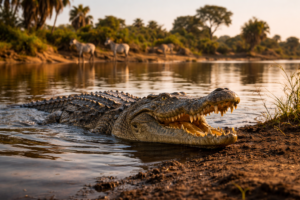
One of the most terrifying aspects is the ambush attack. The predator stays completely submerged, with only its eyes and nostrils visible. It can remain still for long periods, waiting for the perfect opportunity.
When it strikes, it uses a powerful upward lunge, grabbing its target with immense force. What follows is known as the “death roll”—a violent spinning motion designed to disorient and drown prey.
There are documented cases where even large animals like zebras or antelopes are dragged into the water. Humans, in comparison, stand very little chance.
Despite this, many communities have learned to live alongside these predators. They adapt their routines, avoid certain areas, and remain alert.
The reality is simple: these encounters are dangerous not because of frequent aggression, but because of perfectly evolved hunting efficiency.
Physical Characteristics and Bite Force
This is where things get even more intense. The physical design of this reptile is nothing short of extraordinary.
An adult can grow up to 16–20 feet long and weigh over 1,000 kilograms. Its body is built for both stealth and strength. Thick, armored skin protects it from injury, while a powerful tail helps it move swiftly through water.
But the most impressive feature? Its jaws.
The bite force is among the strongest in the entire animal kingdom. Scientists estimate it to be over 5,000 pounds per square inch (psi). To put that into perspective, it’s one of the highest recorded in studies of animals bite force.
Once those jaws snap shut, escape is nearly impossible.
Interestingly, the muscles used to open the mouth are relatively weak. But that doesn’t matter—because once it bites, it doesn’t let go.
Its teeth are conical and designed not for chewing, but for gripping and tearing. Combined with the death roll, this creates a devastating hunting mechanism.
This combination of size, strength, and bite force is what makes it one of the most efficient predators ever evolved.
Where They Live: Habitat and Geographic Distribution
These reptiles are widely distributed across sub-Saharan Africa, thriving in freshwater environments.
They prefer:
- Rivers
- Lakes
- Marshes
- Swamps
You’ll often find them basking along riverbanks during the day, regulating their body temperature. But don’t be fooled—just because one is visible doesn’t mean others aren’t hidden nearby.
Their ability to adapt is remarkable. From large rivers like the Nile to smaller inland water bodies, they can survive in a wide range of conditions.
This widespread habitat is one reason for frequent human interaction. In many regions, water sources are shared spaces, increasing the chances of encounters.
They are also known to travel between water bodies during rainy seasons, expanding their territory.
Understanding where they live is key to understanding their danger. It’s not just about the predator—it’s about proximity to humans.
What They Eat and How They Hunt
These predators sit at the top of the food chain, and their diet reflects that.
They feed on:
- Fish
- Birds
- Antelope
- Zebras
- Smaller reptiles
- Occasionally livestock
Young ones start small, eating insects and fish, but as they grow, so does their prey size.
Their hunting strategy is what truly sets them apart.
They rely on stealth and patience rather than speed. Hours—even days—can be spent waiting for the right moment. When prey comes close to the water’s edge, the attack is sudden and precise.
They grab, drag, and drown.
Sometimes, they store food underwater to let it soften before eating. This behavior shows a surprising level of instinctive intelligence.
Within the animal kingdom, very few predators combine patience, strength, and strategy so effectively.
Behavior, Aggression, and Speed in the Water
Despite their heavy appearance, these reptiles are incredibly agile in water.
They can reach speeds of up to 30–35 km/h in short bursts. On land, they are slower, but still capable of surprising movement over short distances.
Their behavior is largely influenced by:
- Temperature
- Food availability
- Breeding season
Aggression levels rise during nesting periods, when females guard their eggs fiercely. Males can also become territorial, especially in crowded habitats.
But outside these periods, they are mostly energy-efficient animals. They conserve energy, avoid unnecessary movement, and strike only when needed.
This calm, calculated behavior is what makes them so dangerous. There’s no wasted effort—only precise action.
Reproduction, Nesting, and Lifespan
The life cycle begins with nesting, usually during the dry season.
Females lay 40–60 eggs in sandy riverbanks. These nests are carefully chosen to balance temperature and safety.
One fascinating detail is that the temperature of the nest determines the sex of the hatchlings.
Mothers guard the nest aggressively for about 80–90 days. Once the eggs hatch, they even help carry the babies to water in their mouths—a rare display of parental care among reptiles.
Despite this protection, many young do not survive. Birds, fish, and other predators pose constant threats.
Those that do survive can live up to 60–70 years, becoming dominant predators in their ecosystem.
Natural Enemies and Conservation Status
While adults have few natural enemies, young ones face many threats.
Predators of hatchlings include:
- Birds
- Monitor lizards
- Larger fish
Humans, however, remain the biggest threat overall.
Hunting, habitat destruction, and conflict have impacted populations in some regions. Yet, conservation efforts have helped stabilize numbers in many areas.
Currently, their conservation status is considered “Least Concern”, but local populations can vary.
Efforts to protect both humans and wildlife are ongoing. Education and awareness play a key role in reducing conflict.
At bhuchisworld, the goal is to help readers understand not just the danger, but also the importance of coexistence.
Final Thoughts: Respecting a Powerful River Predator
So, how dangerous is the Nile crocodile?
It is undeniably one of the most dangerous predators on Earth—but not because it is mindlessly aggressive. Its danger comes from precision, power, and perfect adaptation.
Understanding it changes the perspective. It’s no longer just a fearsome creature, but a vital part of nature’s balance.
Respect, awareness, and distance—these are the keys to staying safe.
Because in the wild, survival isn’t about dominance. It’s about understanding.
Frequently Asked Questions
What is their bite force?
It’s about 5,000 psi, one of the strongest in the animal kingdom.
Can they run on land?
Yes, short bursts up to 12–14 km/h, but only for brief distances.
What is their average size?
Adults usually grow 16–20 feet long and weigh over 1,000 kg.
Do they eat humans regularly?
No, humans are not primary prey, but attacks happen due to opportunity.
Where are they mostly found?
In rivers, lakes, and wetlands across sub-Saharan Africa.
What eats them?
Only young ones have predators; adults have almost no natural enemies.
How long do they live?
They can live 60–70 years in the wild.
Are they more dangerous than sharks?
Yes, they cause more human deaths annually than sharks.
What should you do if you see one?
Stay calm, keep distance, and slowly move away from the water.
Discover more from Bhuchi's World
Subscribe to get the latest posts sent to your email.







Post Comment