Travel
best time to visit Shetpal, how to reach Shetpal, is Shetpal safe for tourists, Shetpal mystery explained, Shetpal real life video, Shetpal Village, Shetpal village photos, snake friendly village India, visit Shetpal village, why cobras don’t bite in Shetpal, why snakes live in Shetpal
bhuchisworld
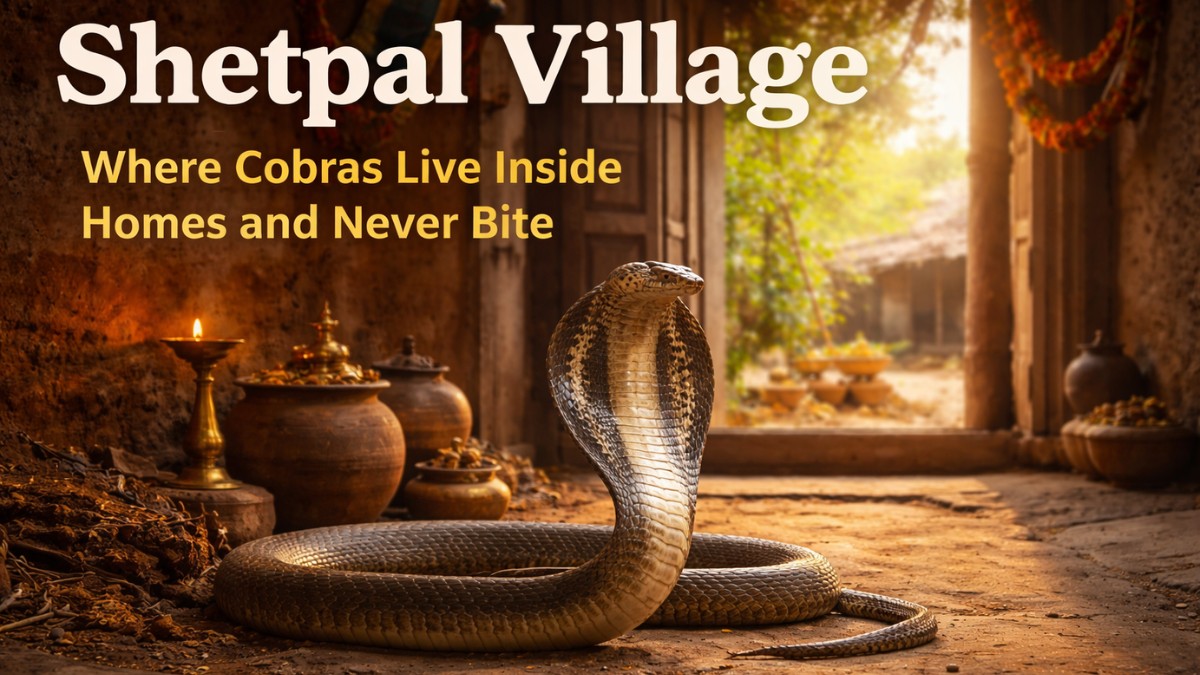
Shetpal Village – Where Cobras Live Inside Homes and Never Bite
You’ve probably seen stories on the internet that sound too strange to be real.
A village where cobras move freely inside homes.
Where people don’t panic at the sight of a snake.
Where no one rushes to kill it… and somehow, no one gets bitten.
It sounds like a myth, doesn’t it?
But this place actually exists.
Welcome to Shetpal, a quiet village in Maharashtra that has become known as India’s snake-friendly village. Here, snakes—especially cobras—aren’t treated as danger. They are treated as guests. Sometimes even as family.
And the most surprising part?
People here don’t live in fear.
They live in understanding.
If you walked into a house in Shetpal, you might notice something unusual—a small, open space built into the wall. It’s not for decoration. It’s not storage.
It’s meant for snakes.
Yes, intentionally.
At first, your instinct might be to step back. Your mind might tell you this is unsafe, unnatural, or even impossible. But the deeper you look into Shetpal, the more you realize something important:
This isn’t about bravery.
This isn’t about superstition alone.
It’s about a completely different relationship between humans and nature—one that most of us have forgotten.
So the real question is not just:
“Why do snakes live in Shetpal?”
But rather…
“What do the people of Shetpal understand that the rest of us don’t?”
The Village That Treats Snakes Like Family
When you first hear about Shetpal, it feels like a place built on courage.
But when you look closer, you realize—it’s not courage at all.
It’s normal life.
In Shetpal, children grow up seeing snakes the same way you grew up seeing birds or street dogs. There’s no sudden panic, no shouting, no instinct to run. A cobra passing through a home isn’t treated as an emergency.
It’s just… a visitor.
This mindset didn’t appear overnight. It’s been quietly passed down through generations. Parents don’t teach fear here—they teach awareness. They show their children how to stay calm, how to give space, and most importantly, how not to disturb the snake.
Because in Shetpal, the rule is simple:
“If you don’t harm them, they won’t harm you.”
And over time, this belief has shaped behavior on both sides.
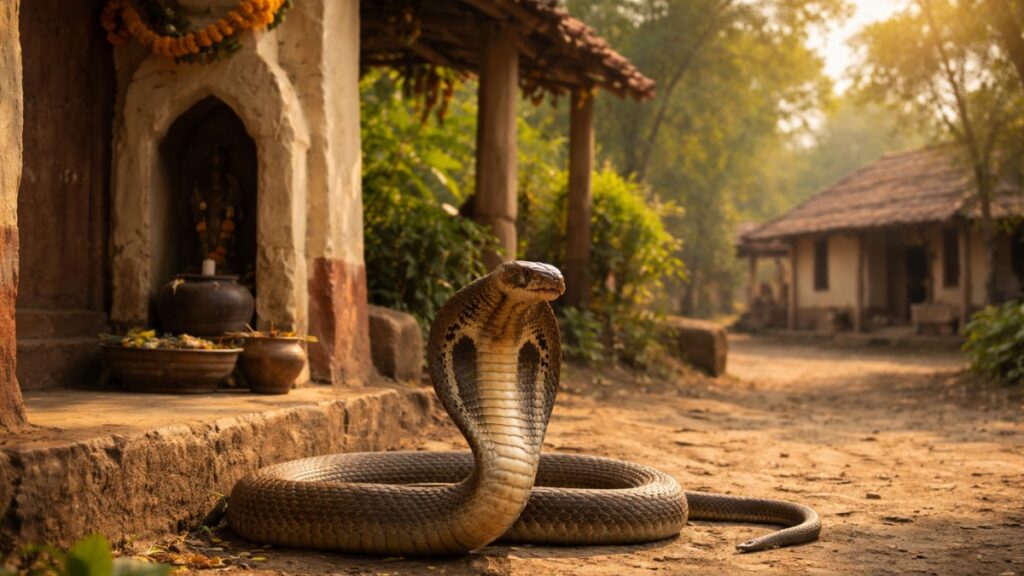
Every house in the village traditionally includes a small space called a Devsthan—a dedicated resting spot for snakes. It’s left open, undisturbed, almost like an unspoken invitation. Not because people want snakes inside their homes, but because they’ve accepted that they share the same environment.
You won’t find people trying to chase snakes away with sticks.
You won’t see panic-driven reactions.
Instead, you’ll notice something unusual—calm observation.
If a snake enters a house, people simply step aside. They let it move. They don’t corner it, touch it, or provoke it. And eventually, the snake leaves on its own.
This quiet understanding changes everything.
Because most snake bites don’t happen randomly. They happen when a snake feels threatened—when it’s stepped on, startled, or trapped. But in Shetpal, those triggers are almost completely absent.
And that’s where the real difference begins.
It’s not that snakes here are “friendly” in the way we imagine.
It’s that humans here have learned not to become a threat.
When you see this in real life, something shifts inside you. The fear you’ve always associated with snakes starts to feel… learned, not natural.
And that realization stays with you.
Why Snakes Live Freely in Shetpal
At some point, you stop asking what is happening in Shetpal…
…and start asking why it even exists in the first place.
Because a village doesn’t just wake up one day and decide to live with cobras.
This way of life is rooted in something much deeper—belief, tradition, and a quiet respect for nature that has been carried forward for generations.
In many parts of India, snakes are not seen as enemies. They are connected to spirituality, especially to Lord Shiva, who is often shown with a serpent around his neck. For many families, snakes are not just animals—they are symbols of protection, balance, and divine presence.
In Shetpal, this belief isn’t occasional or symbolic.
It’s lived every single day.
There’s also a long-standing tradition of honoring snakes during festivals like Nag Panchami, where people offer prayers and show respect instead of fear. But what makes Shetpal different is that this respect isn’t limited to a festival.
It has become a lifestyle.
Over time, the villagers stopped seeing snakes as something “other.” Instead, they became part of the same shared space—like another living being with its own place in the ecosystem.
And slowly, something interesting happened.
Snakes stopped being treated like intruders.
Because they were never treated as intruders to begin with.
The presence of Devsthan spaces inside homes reflects this mindset. These aren’t traps or cages. They are simply quiet corners—left undisturbed—where a snake can rest if it enters.
No force. No interference.
Just acceptance.
From a practical point of view, Shetpal is also surrounded by natural farmland and open areas, which are ideal habitats for snakes. So their presence isn’t unusual. What’s unusual is how people respond to that presence.
Instead of trying to eliminate snakes, the villagers adjusted their behavior around them.
And that one shift changed everything.
Because coexistence doesn’t happen when one side dominates the other.
It happens when both learn to exist without conflict.
That’s exactly what you’re seeing in Shetpal.
Not a miracle.
Not a myth.
But a long-evolved understanding between humans and nature.
Why Cobras Don’t Bite in Shetpal – The Truth
This is the part that pulls everyone in.
You hear about Shetpal and the first question that comes to your mind is simple:
“How is it possible that cobras don’t bite anyone here?”
It sounds almost unbelievable. After all, cobras are among the most feared snakes in the world. Their venom is powerful, and their warning display alone is enough to make anyone step back.
So what’s really happening in Shetpal?
Is it luck?
Is it belief?
Or is there something more grounded behind it?
The truth is much simpler than it seems.
Cobras don’t bite unless they feel threatened.
That’s not a theory—it’s basic snake behavior.
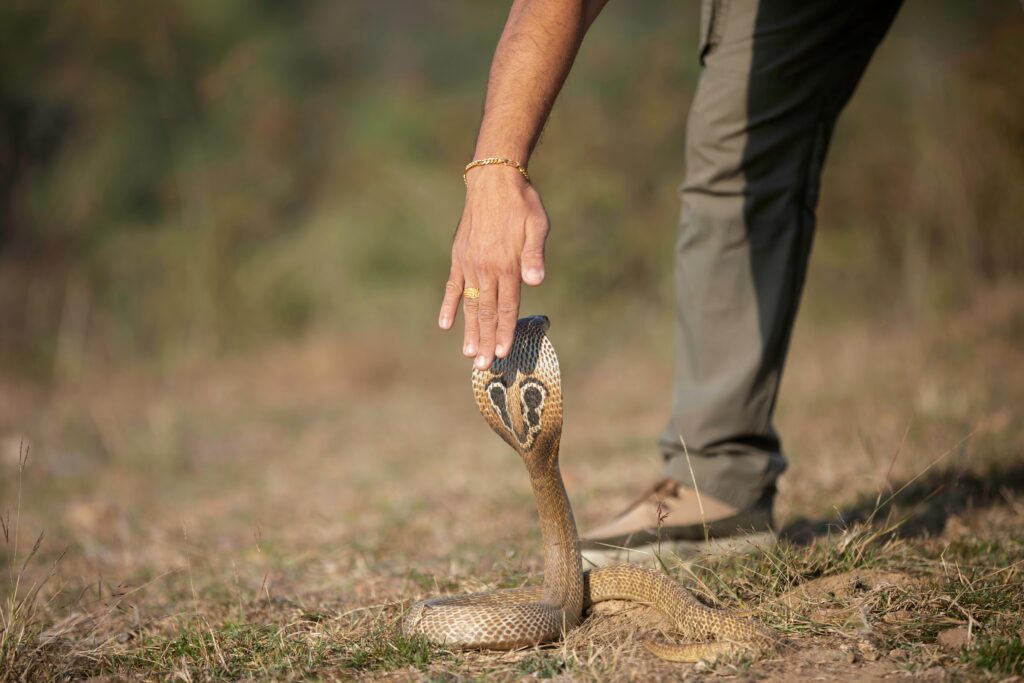
A cobra doesn’t chase humans. It doesn’t attack for no reason. Its first instinct is always to avoid conflict. When it senses danger, it gives warnings—like raising its hood or hissing. Biting is usually the last step, not the first.
Now think about how most snake bites happen in everyday situations:
- Someone accidentally steps on a snake
- Someone tries to catch or kill it
- The snake gets cornered with no escape
In all these cases, the snake reacts because it feels trapped or threatened.
But in Shetpal, these situations are almost completely avoided.
People don’t try to touch snakes.
They don’t chase them away aggressively.
They don’t create panic.
Instead, they do something very simple:
They give the snake space.
And that changes everything.
When a cobra enters a home in Shetpal, no one blocks its path. No one corners it. There’s no sudden movement to trigger fear. The snake senses that it’s not in danger—and so, it doesn’t behave defensively.
It simply moves through and leaves.
Over time, this pattern repeats again and again. Humans don’t threaten snakes. Snakes don’t feel the need to defend themselves.
That’s why incidents are extremely rare.
But here’s something important to understand:
This doesn’t mean cobras in Shetpal are “harmless” or “trained.”
They are still wild animals.
The difference is not in the snake.
The difference is in human behavior.
And once you see it that way, the mystery starts to fade.
Because what looks like a miracle from the outside…
is actually a result of awareness, patience, and respect on the inside.
The Real Mystery of Shetpal Explained
By now, the story of Shetpal starts to feel less like a mystery…
…and more like something quietly logical.
But still, a part of you might be wondering:
“Is that all? Just behavior and belief?”
It feels like there should be something more hidden. Something unusual. Something almost magical.
But the truth is—there isn’t.
The “mystery” of Shetpal is not about snakes.
It’s about how humans choose to live.
In most places, fear is the first reaction. When we see something unfamiliar or dangerous, we panic. We act quickly. We try to remove the threat.
And in doing so, we often create the very danger we’re trying to avoid.
Shetpal works differently.
Here, people don’t react instantly. They observe first. They understand patterns. They grow up knowing that snakes are part of their surroundings—not something separate from it.
This creates a completely different environment.
Not just physically, but mentally.
There’s also an ecological balance at play. Shetpal is surrounded by farmland, open spaces, and natural habitats where snakes belong. They aren’t forced into tight, urban corners. They have space to move, hide, and survive without constant human interference.
So when a snake enters a home, it’s not invading—it’s just passing through a shared landscape.
And because no one reacts aggressively, the situation never escalates.
Another important layer is familiarity.
In cities, a single snake sighting creates chaos because it’s rare and unexpected. But in Shetpal, people have seen snakes their entire lives. There’s no shock factor. No sudden fear response.
Just awareness.
And when fear is removed, reactions become calmer. Movements become slower. Decisions become safer.
That alone reduces risk more than anything else.
So when people say:
“Cobras don’t bite in Shetpal,”
what they really mean is:
“Situations that lead to snake bites rarely happen here.”
And that’s a big difference.
Because the mystery was never about the snakes behaving differently.
It was always about humans choosing to behave differently.
And once you understand that, Shetpal stops feeling like an impossible place…
…and starts feeling like a rare example of something we’ve lost—
a natural, respectful balance between humans and the world around them.
Inside a Shetpal Home – The Devsthan You Won’t Expect
If there’s one moment that truly changes how you see Shetpal…
it’s when you step inside a home.
From the outside, everything looks like a typical rural house. Simple structure, quiet surroundings, nothing that immediately feels unusual.
But then someone points to a small opening in the wall.
At first, it doesn’t look like much.
A hollow space. A niche. Almost like a small shelf carved into the structure.
And then you realize—
this space is not for decoration.
It’s called a Devsthan.
A place intentionally left for snakes.
Yes, inside the house.
There are no doors covering it. No barriers. No attempt to block entry. It’s just there—open, calm, undisturbed.
Not because people expect a snake to be there all the time…
…but because they accept that it might be.
That small detail says everything about how Shetpal thinks.
In most homes, we design spaces to keep nature out—sealed windows, closed doors, barriers everywhere. But here, there’s a quiet acknowledgement that humans are not separate from nature.
They are part of it.
And sometimes, that means sharing space.
When a snake enters a house, it may rest in the Devsthan for a while. No one disturbs it. No one tries to remove it forcefully. Life simply adjusts around its presence.
People walk carefully. They stay aware. They give distance.
And eventually, the snake leaves.
There’s no drama. No panic. No sudden reaction.
Just patience.
For you, standing there and seeing this for the first time can feel surreal. Your instincts might still be on edge. Your mind might keep reminding you of everything you’ve been taught about danger.
But the people around you aren’t tense.
They’re calm.
And that contrast is what stays with you.
Because the Devsthan isn’t just a physical space.
It’s a reflection of a mindset—
one that chooses coexistence over control.
Read More :Rarest Villages in India: Stories That Feel Almost Unreal
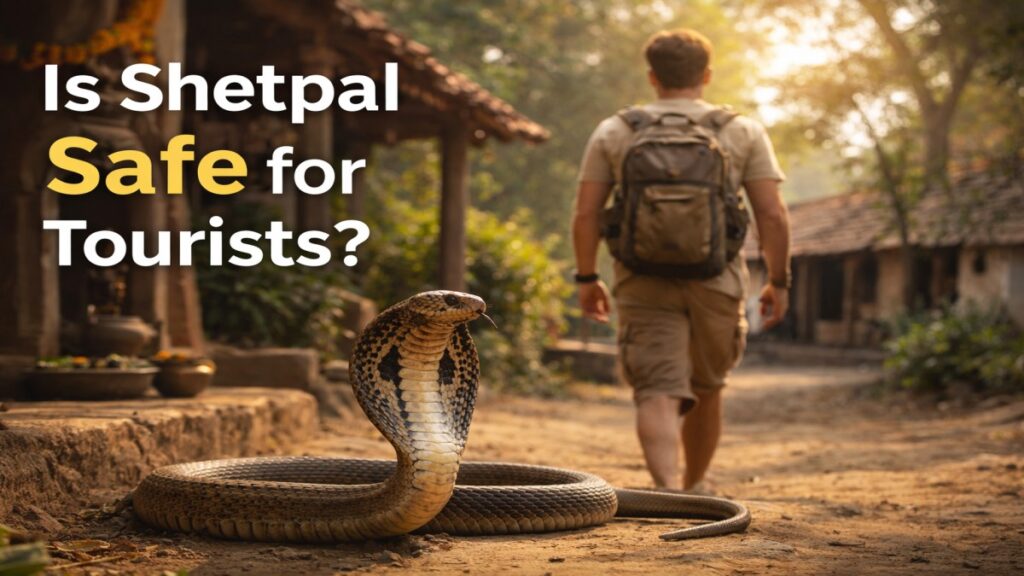
Is Shetpal Safe for Tourists? (Honest Answer)
This is the question you’re probably holding in the back of your mind:
“It sounds fascinating… but is it actually safe to visit?”
The honest answer is:
Yes—Shetpal can be safe for tourists.
But only if you respect the environment you’re stepping into.
This isn’t a zoo.
It’s not a controlled tourist attraction.
It’s a real village where people live their daily lives—with snakes as part of that life.
And that means one important thing:
Your safety depends on your behavior.
If you visit Shetpal expecting to “see snakes up close” or trying to create an experience for photos or videos, you’re approaching it the wrong way—and that’s where risk begins.
But if you visit with awareness, patience, and respect, the experience is generally calm and uneventful.
Here’s what you need to understand clearly:
What Makes It Relatively Safe
- Snakes are not provoked or disturbed
- Villagers are experienced and aware of their surroundings
- Encounters happen naturally, not forcefully
- The environment is open, not crowded or chaotic
What You Should Never Do
- Don’t try to touch or handle a snake
- Don’t block its path or corner it
- Don’t panic or make sudden movements
- Don’t rely on myths like “they never bite”
Because here’s the reality:
Cobras in Shetpal are still wild animals.
They are not trained. They are not harmless.
The reason incidents are rare is because people avoid creating dangerous situations—not because danger doesn’t exist.
Simple Safety Mindset to Follow
Think of it this way:
You’re not going there to interact with snakes.
You’re going there to observe a way of life.
Walk slowly. Stay aware of your surroundings. Listen to locals. And most importantly—don’t try to turn the visit into a thrill.
If you approach Shetpal with curiosity instead of excitement-driven risk, you’ll likely leave with something far more valuable than a “close encounter.”
You’ll leave with a new perspective.
And that’s really what makes Shetpal special.
Not the snakes.
But the way people have learned to live without fear—and without forcing control.
How to Reach Shetpal Village
By the time you reach this point, the curiosity usually turns into a plan.
You’re no longer just wondering about Shetpal…
You’re thinking, “Can I actually go there?”
The answer is yes. But getting there requires a bit of planning, because Shetpal is still a quiet rural village—not a commercial tourist destination.
📍 Where Exactly Is Shetpal?
Shetpal is located in the Solapur district of Maharashtra, not very far from the city of Solapur.
That makes Solapur your main entry point.
🚆 By Train (Most Practical Option)
- Reach Solapur Railway Station
- It’s well connected to major cities like:
- Mumbai
- Pune
- Hyderabad
From Solapur, Shetpal is about 20–25 km away.
You can:
- Hire a local taxi
- Take an auto-rickshaw (if available)
- Or use local buses (less frequent but budget-friendly)
🚗 By Road (Best Experience)
If you enjoy road trips, this is actually the best way to reach Shetpal.
- From Solapur → Shetpal: ~30–40 minutes drive
- Roads are decent, passing through quiet rural landscapes
If you’re coming from:
- Pune: ~250 km (5–6 hours)
- Hyderabad: ~300 km (6–7 hours)
Driving gives you flexibility and makes the journey part of the experience.
✈️ By Air
The nearest major airports are:
- Pune Airport
- Hyderabad Airport
From there, you’ll need to continue by road or train to Solapur.
🧭 Final Tip Before You Go
Shetpal is not a “tourist setup” with signboards and guided tours everywhere.
So it helps to:
- Use GPS navigation
- Ask locals once you’re near Solapur
- Plan your visit during daytime
When you finally enter the village, don’t expect a grand welcome sign or a curated attraction.
It will feel simple. Quiet. Almost ordinary.
And that’s what makes the experience real.
Best Time to Visit Shetpal
Now that you know how to reach Shetpal, the next question becomes:
“When should you actually go?”
Because timing changes everything—not just the weather, but the entire experience.
🌤️ October to February (Best Time Overall)
If you want a comfortable and balanced visit, this is the ideal window.
- Weather is pleasant and not too hot
- Villages feel calm and easy to explore
- Travel is smoother without extreme conditions
This is the time when you can walk around, observe, and take in the experience without feeling rushed or exhausted.
🌧️ Monsoon (June to September) – Lush but Unpredictable
During the monsoon, the surroundings turn green and beautiful.
- Fields look alive
- The village feels fresh and vibrant
But there’s something important to keep in mind:
Snakes tend to be more active during this time due to increased moisture and movement in their natural habitat.
That doesn’t mean it’s dangerous—but it does mean you need to be more alert and mindful while walking around.
Also, roads can be slightly tricky depending on rainfall.
☀️ Summer (March to May) – Not Ideal
Summers in this region can be intense.
- High temperatures
- Dry surroundings
- Daytime travel can feel exhausting
You can visit, but it’s not the most comfortable time—especially if you plan to explore the village on foot.
🐍 Visiting During Nag Panchami (Unique Cultural Experience)
If you want to witness the cultural side of snake reverence, visiting around Nag Panchami can be meaningful.
- You’ll see rituals and traditions centered around snakes
- The spiritual connection becomes more visible
But it’s also a time when there may be more activity and attention around snakes, so it’s important to stay respectful and not treat it like a spectacle.
🧭 Simple Recommendation
If this is your first visit:
👉 Choose October to February
👉 Visit during the daytime
👉 Keep your expectations simple—not sensational
Because Shetpal is not about “catching a moment.”
It’s about slowly understanding a way of life.
And that understanding becomes clearer when you’re not distracted by heat, rain, or discomfort.
What You Actually Feel When You Visit
By the time you leave Shetpal, something feels… different.
Not dramatic.
Not overwhelming.
Just quietly different.
You came here with curiosity—maybe even disbelief. A part of you expected something unusual, maybe even unsettling. After all, how often do you walk into a place where cobras move freely?
But what stays with you isn’t fear.
It’s the absence of it.
You notice how calm everything feels. No urgency. No chaos. No constant need to control every situation. Life moves slowly here, but not carelessly—just with awareness.
And somewhere in that stillness, you begin to reflect.
Because Shetpal doesn’t just show you how people live with snakes.
It shows you something deeper:
How much of your fear is learned… and how much of it is actually necessary.
You start to realize that in most places, we react before we understand. We panic before we observe. And in doing so, we often create the very situations we’re trying to avoid.
But here, the approach is reversed.
Observe first.
Respect space.
Act only when needed.
And that simple shift changes everything.
You may not walk away wanting to live with snakes. That’s not the point.
But you do walk away with a new perspective—on fear, on coexistence, and on how humans can live alongside nature without constantly trying to dominate it.
Shetpal doesn’t try to impress you.
It doesn’t try to prove anything.
It just quietly exists, the way it always has.
And maybe that’s why it stays with you long after you’ve left.
Discover more from Bhuchi's World
Subscribe to get the latest posts sent to your email.













Post Comment