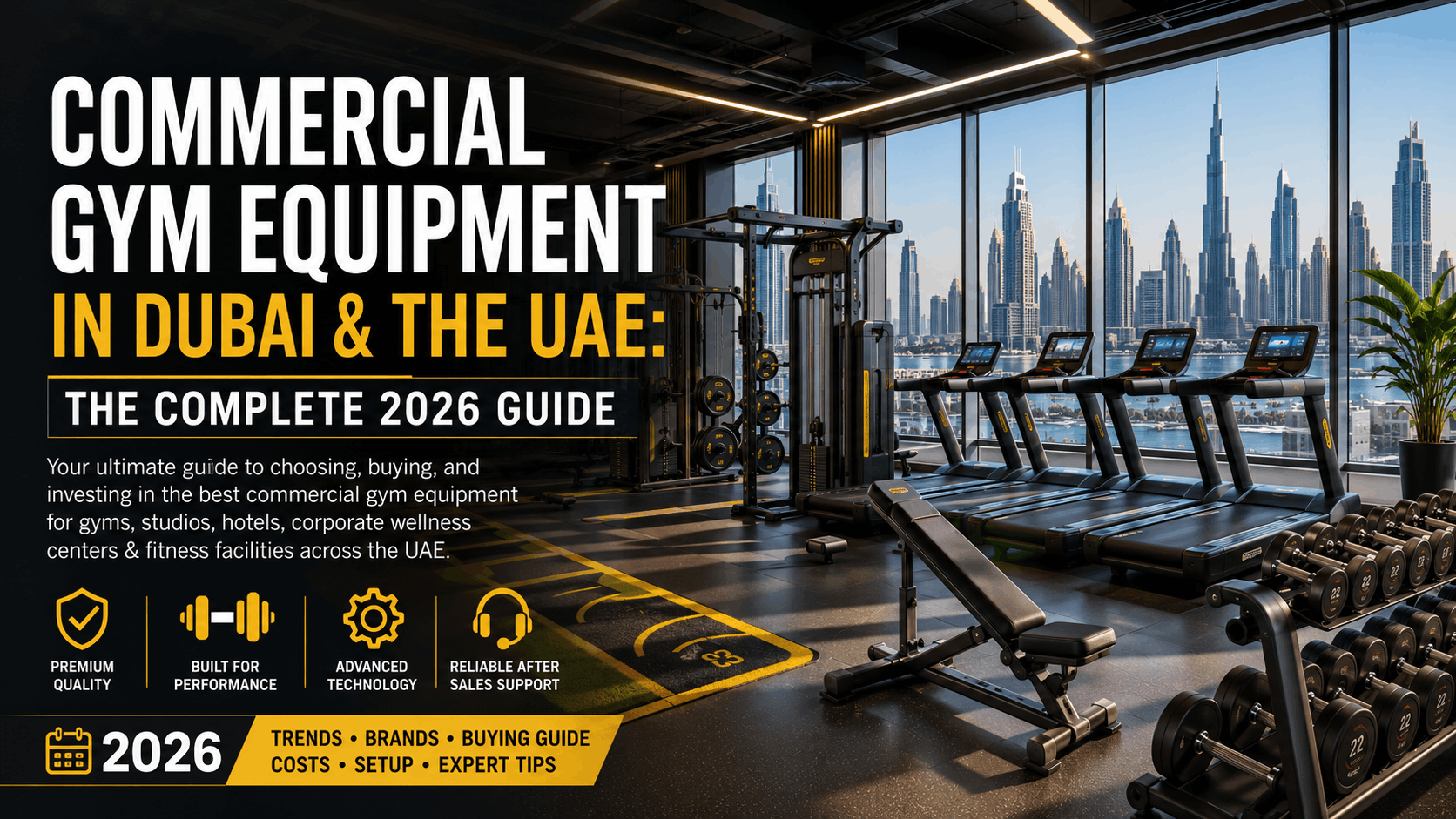
Commercial Gym Equipment in Dubai & the UAE: The Complete 2026 Guide
The commercial gym equipment market in the Middle East has entered a period of significant, data-confirmed growth. According to IndexBox, the region’s gym and fitness equipment market reached $608–643 million in 2024, a year-on-year jump of 11–19%, with the UAE ranking as the third-largest consuming country in the region alongside Turkey and Saudi Arabia — together accounting for 70–73% of total regional volume.
At the club level, the UAE health and fitness club market reached USD 484.4 million in 2024 and is projected to grow to USD 742.9 million by 2033 (CAGR of 4.37%), according to IMARC Group. Some analysts project the broader UAE fitness economy — including digital and wellness segments — will surpass USD 5 billion by 2030.
This growth is not incidental. It is driven by a convergence of government policy, demographic trends, hospitality expansion, and one of the most wellness-conscious consumer bases in the world.
The Demand Drivers: What’s Actually Fueling Equipment Investment
Government-Led Fitness Initiatives
The UAE government has made physical fitness a national priority. The Dubai Fitness Challenge (DFC), launched in 2017 by HH Sheikh Hamdan bin Mohammed bin Rashid Al Maktoum, has accumulated over 16 million cumulative participants, with the 2025 edition alone drawing a record 3 million participants — including over 307,000 runners and 40,000 cyclists. The initiative challenges residents to complete 30 minutes of activity daily for 30 days (the 30×30 model).
In December 2025, the DFC launched Dubai Transform, a 90-day workplace wellness program targeting UAE government employees, integrating gym memberships, biomarker testing, nutritional consultations, and wearable devices.
At the national level, the UAE National Sports Strategy 2031 targets 71% of the population participating in sports, delivered through 17 transformational initiatives.
A Public Health Imperative
Wellness investment in the UAE is also responding to a serious public health reality. Studies published in Diabetes, Obesity and Metabolism (2025), based on data from nearly half a million Dubai residents, found that 63.4% of the population surveyed were living with overweight or obesity, with UAE nationals at 68.3%. Separately, December 2024 health statistics indicate that 44.2% of adult women and 30.9% of adult men in the UAE are classified as obese. Diabetes and obesity currently affect an estimated 20% of the UAE population.
This data creates a structural, long-term demand driver for commercial fitness infrastructure — not as a luxury, but as a health necessity.
Consumer Spending Intention Is Exceptional
According to GymNation’s 2025 UAE & KSA Health & Fitness Report, 62% of UAE residents plan to increase their health and fitness spending in 2025 — more than double the 24% rate recorded in the UK. A striking 94% of Gulf residents surveyed aspire to live healthier lives, and 92% view exercise as critical for mental well-being.
Additionally, 88% of UAE companies are planning to enhance employee fitness initiatives, pointing to significant growth in corporate gym investment.
Boutique and Chain Gym Expansion
The UAE fitness market is attracting serious capital. Recent deals illustrate the scale of investment:
- GymNation invested approximately USD 19 million (AED 70 million) in December 2024 to acquire and expand its Motor City facility, reinforcing its position as the largest gym chain in the UAE.
- Arada acquired FitnGlam, The Platform Studios, and FITCODE in December 2024, expanding its Wellfit portfolio to 15 gyms with 11 more planned.
- Lift Brands (Snap Fitness) reclaimed its UAE master franchise in March 2025, targeting refurbishment and expansion of existing clubs.
The Commercial Equipment Market: What’s Selling and Why
Cardiovascular Equipment Dominates — But Smart Technology Is the Real Story
Cardiovascular training equipment holds the largest segment share at 48.4% of the Middle East and Africa fitness equipment market (2024, Data Bridge Market Research), driven by treadmills, stationary bikes, and elliptical trainers. These remain the anchor purchase for hotel gyms, fitness clubs, and corporate wellness centers alike.
However, the real competitive differentiator is no longer the machine itself — it is the technology ecosystem surrounding it. As of 2025, “smart fitness” is no longer an add-on feature; it is, as one industry report puts it, “the price of entry.” Leading platforms like Technogym’s Open Platform now sync with over 100 fitness apps, giving clubs a complete feedback loop on user behavior and member retention.
What modern commercial treadmills must offer:
- Powerful commercial-grade motors designed for multi-hour daily usage
- Integrated HD touchscreens with streaming and entertainment capability
- Mobile app and wearable synchronization
- Cloud-based workout tracking and performance analytics
- Shock-absorption systems for joint-safe training
- High user weight capacity and durable belt construction
- Energy-efficient operation (some models self-power through user movement)
Strength Equipment: Selectorized, Plate-Loaded, and AI-Enabled
Strength training systems span three core categories for commercial facilities:
Selectorized machines (weight-stack systems) remain the standard for hotel gyms and general fitness clubs due to ease of use, safety, and minimal training required. Plate-loaded systems are preferred by performance and athletic training facilities. Free weight sections — comprising dumbbells, Olympic barbells, squat racks, adjustable benches, and storage systems — are non-negotiable for premium clubs targeting serious fitness members.
An increasingly important category: AI-enabled resistance training platforms such as Vitruvian and Tonal, which offer adaptive resistance in real time. Research cited in fitness industry analyses suggests real-time adaptive resistance can improve muscle engagement by up to 40% compared to static load training — making these systems particularly attractive to high-end boutique studios and corporate wellness facilities targeting performance outcomes.
Functional Training: The Fastest-Growing Zone
Functional training is among the fastest-growing segments in the UAE commercial fitness market, and for good reason: it appeals to the widest possible user demographic, from athletes and personal training clients to rehabilitation patients and group fitness participants.
Modern functional training areas in UAE commercial facilities now incorporate:
- Modular functional rigs and cable systems
- Suspension training anchors
- Battle ropes and resistance bands
- Kettlebells, medicine balls, and sandbags
- Plyometric platforms and turf tracks
- Sled push systems and agility equipment
- Boxing stations
The trend toward modular, multipurpose layouts is particularly relevant for Dubai facilities, where floor space is expensive and operators need to maximize utilization across multiple training modalities simultaneously.
Facility-by-Facility Equipment Guide
Large-Scale Fitness Clubs
Large clubs handle the highest daily equipment usage and require the broadest equipment mix. They typically invest in:
- 10–20+ commercial treadmills with interactive displays
- Multiple cardio modalities (elliptical, bike, rower, stair climber, air bike)
- Complete selectorized machine circuits
- Plate-loaded systems for advanced users
- Full free weight areas with dumbbell ranges up to 50kg+
- Functional training zones with rigs and open floor space
- Group exercise studios with specialty equipment
- Recovery zones with foam rollers, stretching areas, and mobility tools
- Connected fitness infrastructure for member tracking
Key consideration: Connected fitness technology that integrates with gym management software is increasingly a membership retention tool, not just an equipment feature.
Hotel Gyms
The UAE hospitality sector is one of the highest-volume commercial buyers of fitness equipment in the region. Hotel guests range widely in fitness ability, so hotel gyms must balance beginner-friendliness with enough range to satisfy experienced users.
Standard hotel gym equipment configuration:
- 3–6 commercial treadmills
- 2–3 elliptical trainers
- 1–2 upright and recumbent bikes
- Functional trainer or cable system
- Adjustable dumbbell set (typically 2–40kg)
- Adjustable bench
- Stretching and yoga zone
- Recovery accessories
What hotel operators demand from suppliers goes beyond the machines themselves: they require complete turnkey solutions including space planning, 3D layout design, professional installation, preventive maintenance contracts, spare parts management, and warranty support. Because hotel fitness centers operate daily and any downtime affects guest satisfaction, after-sales service is as important as product quality.
Boutique Fitness Studios
Dubai’s boutique studio sector is expanding rapidly, with specialized offerings in HIIT, indoor cycling, boxing, Pilates, yoga, and functional training. Boutique operators differentiate on experience — which means every equipment choice is a brand statement.
Common boutique equipment configurations:
- Indoor cycling studios: 15–30 commercial cycling bikes, often with digital performance tracking
- HIIT studios: Compact functional rigs, rowing machines, air bikes, and kettlebell areas
- Boxing studios: Heavy bags, speed bags, floor-to-ceiling balls, boxing stations
- Pilates and yoga: Reformers, accessories, and soft-surface flooring systems
Space optimization is critical in boutique settings. Suppliers who offer expert floor planning as part of their service provide significant value to boutique operators working with constrained square footage.
Corporate Wellness Centers
Corporate gym investment in the UAE is accelerating, driven by evidence that employee wellness programs improve productivity, reduce absenteeism, and support talent retention. As noted above, 88% of UAE companies plan to enhance employee fitness initiatives — creating substantial demand for corporate-grade equipment.
Corporate gyms prioritize ease of use, minimal maintenance, and equipment that accommodates diverse fitness levels. Common configurations include treadmills, bikes, dumbbells, functional trainers, and stretching zones, with a preference for user-friendly interfaces that require no prior gym experience.
Rehabilitation and Wellness Clinics
Rehabilitation facilities require a fundamentally different equipment approach — biomechanical precision, safety, controlled movement ranges, and low-impact options. Key equipment categories include low-resistance cardio machines, cable rehabilitation systems, stability tools, balance platforms, and mobility training rigs. Supplier expertise in rehabilitation-specific equipment specification is essential for this segment.
The Import Market: Why UAE Facilities Prefer International Brands
The Middle East gym and fitness equipment market is heavily import-dependent. Imports reached $495–501 million in 2024, representing the overwhelming majority of the $608–643 million total market value. This reflects a deliberate buyer preference — not a supply gap.
UAE facility operators prefer imported equipment for several well-documented reasons:
Durability and engineering quality. Commercial-grade imported machines from established international brands are engineered for 8–12+ hours of daily usage, with heavy-duty steel frames, commercial-grade components, and certifiable safety standards. The cost of equipment failure in a busy hotel gym or premium fitness club — in terms of guest experience, member satisfaction, and repair costs — far outweighs any initial price premium.
Technology leadership. The most advanced connected fitness platforms — interactive touchscreens, AI coaching, cloud performance tracking, wearable integration, virtual classes — originate from international manufacturers. Brands like Technogym (Italy), Life Fitness (USA), Matrix, Precor, and Concept2 continue to set the technology standard that UAE premium facilities require.
Brand credibility. For luxury hotels and premium fitness clubs, equipment brand recognition is part of the member and guest experience. International fitness brands help facilities position themselves in the premium segment and command higher membership fees.
Cardiovascular equipment segment leadership. The cardiovascular segment represents 48.4% of the regional market, and it is dominated by imported commercial treadmills, ellipticals, and bikes from international manufacturers.
Smart Technology and the Future of UAE Commercial Gym Equipment
The fitness monitoring equipment segment is forecast to be the fastest-growing category in the Middle East and Africa through 2032, fueled by demand for real-time performance tracking, smart gym ecosystems, and wearable device integration.
Key technology trends reshaping equipment investment decisions in the UAE:
Connected cardio ecosystems. Members can now track workout performance, sync wearable data, access virtual coaching, stream entertainment, and join live fitness classes — all from a treadmill or bike console. Operators who invest in connected equipment see measurably better member engagement and retention data.
AI-powered coaching and analytics. Artificial intelligence is moving from fitness apps into the equipment itself, providing real-time movement analysis, personalized workout recommendations, automated form feedback, and performance trend reporting. This is already standard in the highest-performing boutique studios and luxury wellness clubs in Dubai.
Digital gym management integration. Equipment that feeds data directly into gym management platforms enables operators to track per-machine utilization, identify maintenance needs before failure, understand member behavior, and design programming based on actual usage data.
Hybrid fitness models. Dubai’s fitness market is evolving toward combined in-person and digital experiences. Equipment that supports both modes — allowing members to use the physical machine in the club and access the same platform at home or while traveling — is increasingly preferred by operators.
Sustainability. Equipment that generates its own power (self-powered cardio), uses energy-efficient motors, and is constructed from durable long-life materials is becoming an important consideration for operators aligning with UAE sustainability goals.
Luxury Gym Equipment: Dubai’s Premium Segment
Dubai’s global reputation for luxury living extends fully into its fitness infrastructure. Premium hotel groups, luxury residential developments, and high-end fitness brands consistently invest in the top tier of commercial equipment — and the business case is clear: in a market where members pay AED 1,000–5,000+ per month, every detail of the facility experience influences both acquisition and retention.
Luxury commercial gym equipment in Dubai typically features:
- Custom powder-coat finishes and upholstery in brand or interior design colors
- Premium biomechanical engineering for smoother, more ergonomic movement
- HD touchscreen interfaces with streaming, virtual coaching, and entertainment
- Advanced performance analytics with member profile storage
- Premium materials — brushed steel, leather-touch upholstery, matte finishes
- Low-noise operation suited to high-end interior environments
Industries driving luxury equipment investment in Dubai:
- Five-star hotels and resorts: Gym quality directly impacts TripAdvisor ratings and repeat bookings
- Luxury residential towers: Premium fitness centers are now marketed as core amenities, not additions
- Boutique wellness clubs: Premium equipment is the central brand statement
- Corporate headquarters: Global companies use world-class wellness facilities to attract and retain talent
Choosing the Right Commercial Gym Equipment Supplier in Dubai
The choice of supplier determines the long-term success of any gym equipment investment. Product quality is table stakes; the following factors differentiate the best suppliers in the UAE market.
After-Sales Service and Maintenance
This is frequently the most important factor, particularly for hotels and high-traffic facilities. Commercial equipment under heavy daily use will require maintenance. Suppliers should offer:
- Preventive maintenance programs with scheduled visits
- Emergency repair response with defined SLAs
- In-country spare parts inventory for fast turnaround
- Software and firmware update management
- Comprehensive warranty coverage
A supplier who cannot demonstrate a proven maintenance operation in the UAE is a high-risk choice regardless of product quality.
Facility Planning Expertise
The best suppliers offer professional gym design services, including space planning, traffic flow analysis, equipment zoning, and 3D layout visualization. This matters because poor equipment placement — insufficient clearances, awkward traffic flows, suboptimal zoning — directly degrades member experience and operational efficiency. Bringing in a supplier with planning expertise early in the project saves costly redesigns.
Installation and Commissioning
Professional installation ensures correct machine assembly, calibration, safety compliance, and member-ready readiness. For large-scale installations (hotel gyms, fitness clubs, corporate wellness centers), this typically requires a project management approach with defined delivery and installation timelines.
Product Range
The ideal supplier can serve the full equipment mix — commercial cardio, selectorized machines, plate-loaded systems, free weights, functional training systems, and accessories — from a curated selection of trusted international brands. Single-source capability simplifies procurement, logistics, and ongoing account management.
Commercial Gym Space Planning for UAE Facilities
Effective floor planning is as important as equipment selection. Modern UAE commercial gyms are organized around defined training zones:
Cardio Zone: Positioned near windows or entertainment screens to maximize user engagement. Spacing between machines must meet safety clearance standards (minimum 0.5m rear clearance for treadmills) and allow comfortable side-by-side use.
Strength Zone: Organized for logical progression through machine circuits with clear sightlines and adequate free weight area. Olympic lifting areas require ceiling height consideration.
Functional Training Area: Open-plan zones designed for group and individual training. Rubber flooring, ceiling-mounted rig anchor points, and built-in storage for accessories are standard requirements.
Recovery Zone: Stretching mats, foam rollers, and mobility tools positioned away from high-traffic equipment areas to allow focused recovery work.
Group Exercise Studio: Sound-isolated space for instructor-led classes with appropriate flooring, mirror coverage, and equipment storage.
Well-designed UAE gym layouts also account for the climate: indoor facilities must manage air conditioning flow around high-heat-generating cardio equipment, and member comfort during peak usage hours (typically 6–9am and 5–9pm) is a design consideration.
Maintenance: The Overlooked Competitive Advantage
Commercial gym equipment in UAE facilities runs hard. A busy gym or hotel fitness center may see 200–400 individual machine uses per day. Without a disciplined maintenance program, equipment degrades quickly, creating safety risks and member dissatisfaction.
Preventive maintenance fundamentals for commercial equipment:
- Treadmill belt lubrication and tension adjustment (monthly)
- Motor and electronic system inspection (quarterly)
- Cable and pulley system inspection and replacement as needed
- Console and software updates
- Full safety audit and cleaning protocol
Operators who treat maintenance as a cost center rather than an investment in asset protection routinely face higher total costs through premature equipment replacement and emergency repair bills. Leading suppliers in Dubai offer bundled maintenance contracts that deliver measurably lower total cost of ownership over a 5–10 year equipment lifecycle.
Frequently Asked Questions
What is the UAE health and fitness club market worth?
The UAE health and fitness club market reached USD 484.4 million in 2024 and is projected to reach USD 742.9 million by 2033 (CAGR 4.37%), according to IMARC Group. The broader UAE fitness market, including digital fitness, is projected to exceed USD 5 billion by 2030.
What commercial gym equipment do hotels in Dubai typically buy?
Hotel gyms prioritize commercial treadmills, elliptical trainers, exercise bikes, functional trainers, dumbbell sets, and adjustable benches — all with user-friendly interfaces for guests of varying fitness levels. Hotels also require turnkey supplier services including installation, maintenance, and warranty management.
Why is imported gym equipment the preferred choice in the UAE?
The Middle East gym equipment market is import-dependent (imports valued at $495–501 million in 2024), reflecting buyer preference for international brands’ superior engineering quality, advanced technology, and brand credibility in premium market segments.
What makes functional training equipment popular in Dubai?
Functional training appeals to the widest user demographic (athletes, rehabilitation patients, general fitness members, group class participants) and allows operators to activate large floor areas for multiple simultaneous uses. Dubai’s high real estate costs make multifunctional equipment layouts especially valuable.
How important is after-sales maintenance when selecting a gym equipment supplier?
Critical — particularly for high-traffic facilities. Commercial equipment under daily heavy use requires regular preventive maintenance, and any unplanned downtime in a hotel gym or premium club has direct business consequences. Supplier maintenance capability should be evaluated as rigorously as product quality.
What technology features should I look for in commercial gym equipment in 2025?
Connected cardio with app integration and cloud performance tracking, AI-powered coaching feedback, wearable device sync, gym management software integration, and multi-user profile storage are now standard expectations at the premium tier. Fitness monitoring is the fastest-growing equipment segment in the region.
Conclusion
The commercial gym equipment market in Dubai and the UAE is entering a mature phase of growth — one driven not just by aspiration, but by real capital investment, government infrastructure, and an evidence-based public health imperative. With the health and fitness club market approaching half a billion dollars and the broader fitness economy targeting USD 5 billion by 2030, the infrastructure investment required to support that growth is substantial.
For facility operators, developers, hotel operators, and corporate wellness managers, the implications are clear: equipment quality, technology capability, and supplier service standards are no longer differentiators — they are the baseline expectations of a competitive UAE fitness market.
Choosing the right commercial gym equipment and the right supplier is one of the highest-ROI infrastructure decisions a facility can make. Done well, it drives member retention, brand positioning, operational efficiency, and long-term asset value. Done poorly, it creates ongoing maintenance costs, member dissatisfaction, and competitive disadvantage in one of the world’s most demanding fitness markets.
Key Data Sources
- IMARC Group: UAE Health and Fitness Club Market Report 2025
- IndexBox: Middle East Gym and Fitness Equipment Market Analysis 2024–2035
- GymNation: UAE & KSA Health & Fitness Reports 2025 and 2026
- Data Bridge Market Research: Middle East and Africa Fitness Equipment Market 2024
- Dubai Fitness Challenge official data (dubaifitnesschallenge.com)
- Abdelgadir et al., Diabetes, Obesity and Metabolism (2025) — UAE obesity prevalence study
- Coherent Market Insights: Global Fitness Equipment Market 2025–2032
- IMARC Group: UAE Health & Wellness Market Size and Forecast 2033
Discover more from Bhuchi's World
Subscribe to get the latest posts sent to your email.












Post Comment