Srikurmam – The Village Where Vishnu Decided Being a Tortoise Was a Whole Personality
‘ve covered gods who live in mountains, gods who supposedly walked into their own temples and refused to leave, and one god who’s apparently still annoyed about a snake bite from several centuries ago. But I had never, until now, covered a god who took one look at the animal kingdom, pointed at the slowest, shelliest creature in the room, and said “yes, that one, forever.”
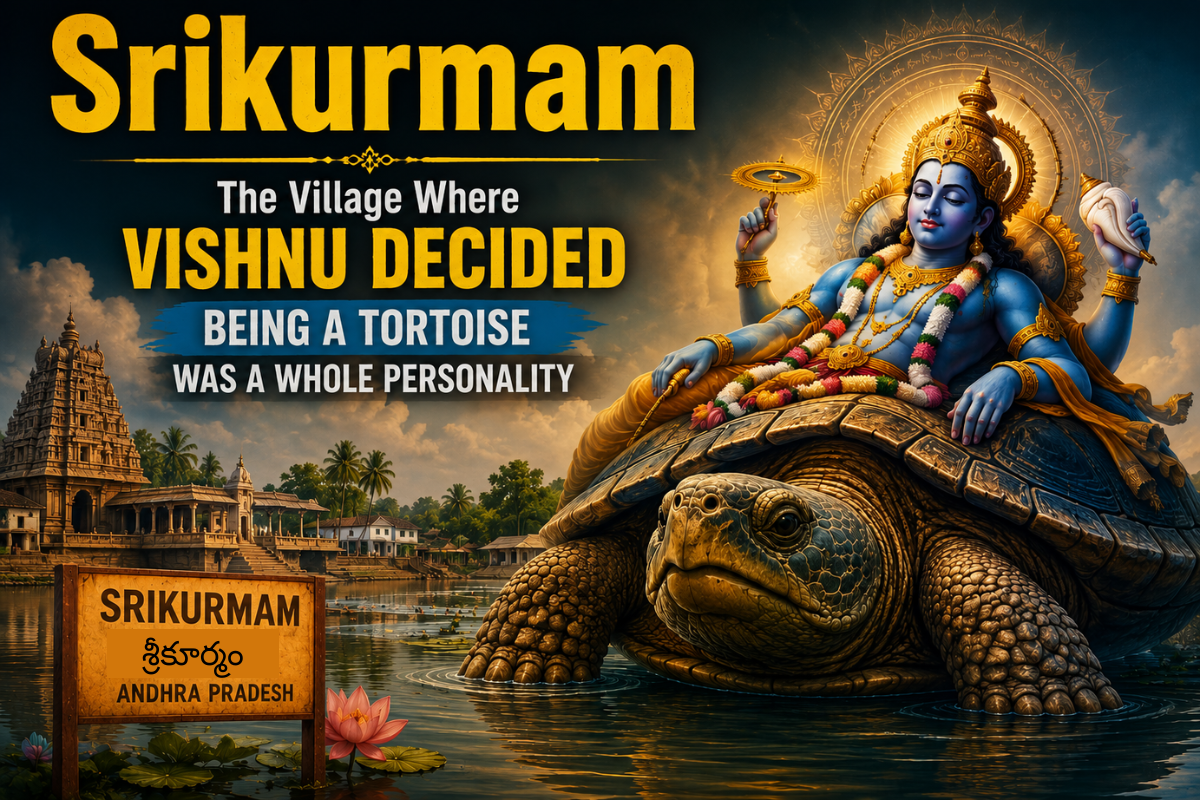
Welcome to Srikurmam a small, quiet, extremely committed village on the Andhra Pradesh coast, a couple of hours from Visakhapatnam, where the local deity isn’t shaped like a tortoise. He just is one. No arms, no crown, no dramatic thousand-hand pose. A stone shell, worshipped as a living god for over a thousand years, in what is officially the only self-manifested temple in India built entirely around this decision. And to make things extra literal, the temple also keeps actual, real, breathing tortoises on-site, presumably so nobody ever forgets the theme.
Before we get into why this place is architecturally and spiritually unusual, I need to tell you the backstory, because it reads less like scripture and more like the world’s most poorly timed relationship drama.
The King Who Really Could Not Wait Five Minutes
Once upon a time, a king named Swetha Chakravarthi ruled this stretch of coastline. His wife, Vishnu Priya, was a devoted follower of Vishnu and, like any sensible person observing an Ekadashi fast, had set the day aside entirely for prayer — no exceptions, no negotiations, and definitely no “just this once, come on.” The king, for reasons Kurmam history has chosen not to flatter him with, decided this was the perfect moment to be persistent about something that was not prayer.
She said no. He didn’t take the hint. She appealed directly to Vishnu, and Vishnu — showing exactly the kind of decisive boundary-setting we could all learn from sent a sudden stream of water to physically separate the two of them, sweeping the king off toward the hills like a divine “please leave a review of this interaction: one star.”
Stranded and humbled, the king ran into the sage Narada, who taught him a mantra dedicated to Vishnu’s tortoise form and told him to get praying. By the time Vishnu finally showed up, the king had exhausted himself completely, so Vishnu used his Sudarshana Chakra to carve out a healing lake on the spot because apparently a chakra can do crowd control and landscaping — and the king recovered. Grateful, and possibly still a little embarrassed, he asked Vishnu to stay right there. Permanently. As a tortoise.
Vishnu agreed. That lake, Swetha Pushkarini, is still sitting beside the temple today, and pilgrims bathe in it before entering the sanctum, blissfully unaware they’re dipping into the site of ancient India’s most awkward marital counseling session.
What Actually Makes This Place Rare (Besides the Vibes)
A lot of travel sites will tell you Srikurmam is “the only temple in the world” dedicated to the Kurma avatar. This is the internet equivalent of your uncle insisting he invented a recipe he definitely got off a jar. It’s not quite true there are two smaller Kurma temples elsewhere in India, one near Chitradurga in Karnataka and another in Kurmai, Chittoor district. What is genuinely, verifiably true is that Srikurmam is the only swayambhu Kurma temple — self-manifested, not carved by a sculptor with a deadline — and the oldest one on record, with inscriptions and architecture predating the 14th century. So it’s not the only member of the club. It’s just the founder, and everyone else is basically a tribute act.
The temple has a second flex worth mentioning: most Vishnu temples have exactly one ceremonial flagpole. Srikurmam has two, east and west, which local tradition blames on a visit from the philosopher-saint Ramanujacharya — the story goes that the original flagpole physically turned to face him on arrival, so naturally the temple installed a second one just to be safe. I don’t know what the HR policy is for flagpoles that develop opinions, but I respect the commitment to documentation.
And then there’s the worship style, which is its own small miracle of interfaith cooperation. Srikurmam actually started out as a Shiva temple, known as Kurmeswara, before being converted to Vaishnava worship in the 11th century. But instead of a clean break, the temple kept performing daily abhisheka — the ritual bathing of the deity — a practice usually reserved for Shiva shrines. So today, mornings lean Vaishnava, evenings lean Shaiva, and the temple has essentially been co-parenting two major branches of Hinduism under one roof for the better part of a millennium without a single custody dispute.
The Actual Living Roommates
Here’s the part where the temple stops being merely symbolic and starts being genuinely delightful: inside the complex, there’s a dedicated tortoise park, home to over 250 star tortoises — an endangered species under India’s Wildlife Protection Act, and, unofficially, the most spoiled reptiles in Andhra Pradesh.
For generations, locals who’ve found tortoises wandering the nearby fields have handed them over to the temple as offerings, on the logic that if your god is a tortoise, looking after tortoises is basically direct-deposit devotion. Visitors feed them gongura leaves — a sour, locally beloved green — which, if you think about it, makes this possibly the only temple in India where the offering plate doubles as a salad bar for the divine’s actual relatives.
This system briefly went sideways in 2011, when reports surfaced that the tortoises weren’t being properly fed, sheltered, or protected from predators — essentially, holy neglect. A conservation NGO called Green Mercy stepped in, escalated things to the forest department, and the whole situation ended up in the Andhra Pradesh High Court after devotees pushed back against having the tortoises relocated. The compromise: the temple got to keep its tortoises, but only if it started actually taking care of them like the sacred responsibility they are and not like background decor. By 2014, the redesigned conservation program had produced over fifty successfully bred hatchlings — proof that nothing motivates proper animal husbandry quite like a judge getting involved.
Seven Hundred Years and Still Standing (Mostly Undisguised)
The current temple structure is a little over 700 years old, though tradition insists the worship here goes back considerably further, with mentions across the Kurma, Vishnu, Padma, and Brahmanda Puranas which is either impressive continuity or the world’s longest-running family business, depending on how you look at religion.
Architecturally, it’s a genuine mash-up of Kalinga style from neighboring Odisha and Dravidian style from further south, which tracks, given the temple sits almost exactly on the cultural border between the two. The sanctum’s roof is shaped like an eight-petalled lotus, and the surrounding mandapa is held up by 108 pillars, each cut from a single block of stone, no two alike — a level of individual craftsmanship your average flat-pack furniture store will never, ever match.
My favorite detail, though, is what happened during periods of invasion from the Deccan Sultanate: devotees reportedly coated the entire temple in limestone to disguise it as an unremarkable hillock. A thousand-year-old temple, dressed up as a boring lump of rock specifically to avoid attention genuinely the most relatable thing a building has ever done. The temple was clearly beloved enough that, centuries later, it got the ultimate modern seal of approval: its own postal stamp, issued in April 2013, because if you’re going to be famous in India, eventually you end up on an envelope.
Festival Calendar: When Srikurmam Really Turns It Up
Most of the year, Srikurmam is the kind of place where the loudest thing happening is a rooster having an opinion. Then a handful of days roll around when the whole village essentially throws a party for a tortoise, and honestly, it’s worth timing your trip around one of them. Here’s the full rundown what each one means, why it matters, and 2026/2027 dates so you don’t show up on a random Tuesday wondering where everyone went.
| Festival | What It’s About | Why It Matters | 2026 Date | 2027 Date |
|---|---|---|---|---|
| Dolotsavam (Brahmotsavam) | 3-day flagship festival, timed with Holi | The temple’s biggest event by far — deity processions, music, dance, thousands of visitors from AP and Odisha | Around March 3–5 | Around March 21–23 |
| Kurma Jayanti | Marks the day Vishnu “birthed” as a tortoise | Special abhisheka and a town procession this is the tortoise-specific holiday | May 1 (pan-India tradition) or July 11 (the temple’s own local observance) | Check closer to the date — this one shifts with the lunar calendar |
| Vaikuntha Ekadashi (Mukkoti Ekadashi) | The symbolic “gates of heaven” day for Vishnu devotees | One of the most spiritually loaded days in the Vaishnava calendar; the temple gets noticeably fuller | December 20 | December 9 |
| Vaarshika Kalyanotsavam | The deity’s annual “wedding” celebration | Marks the divine marriage of Kurmanatha and Kurmanayaki, celebrated with full floral decorations | Late April (around Vaisakha Ekadashi) | Late April (confirm via local panchang) |
A quick honesty check on that Kurma Jayanti row, because I promised earlier I wouldn’t just repeat whatever the internet insists is true: most of India celebrates Kurma Jayanti on Vaishakha Purnima, somewhere in the April–May window. But Srikurmam’s own temple tradition runs on a different clock entirely, observing it on Jyeshtha Krishna Dwadashi instead, which lands in early July. So if you ask ten different sources when Srikurmam celebrates its own signature festival, you’ll get two different answers, and both are technically correct depending on which calendar the person is holding. All Hindu festival dates here follow the lunar calendar rather than the Gregorian one, so treat these as reliable estimates and double-check against a local panchang the closer you get, especially for 2027, when several of these hadn’t been finalized by any panchang at the time of writing.
Dolotsavam is the one worth actually building a trip around. It’s the temple’s flagship event essentially Srikurmam’s version of a hometown carnival — with the deities taken out of the sanctum and paraded through the village accompanied by music, dance, and a level of devotional enthusiasm that makes it very clear this is not a quiet Tuesday darshan.
Vaikuntha Ekadashi is the more solemn, spiritually heavy option. This is the day devotees believe the gates to Vishnu’s own heaven crack open, so expect fasting, all-night prayer vigils, and a temple that’s noticeably fuller than usual impressive, given this is already a village unusually devoted to reptiles.
Vaarshika Kalyanotsavam, the annual celestial wedding of Kurmanatha and his consort Kurmanayaki, is arguably the prettiest of the bunch on paper — full floral décor, the works — but draws far less foot traffic than the other two, which makes it a solid pick if you want the atmosphere without the crowd control.
Outside festival season, the temple runs fairly standard daily timings roughly sunrise to 8 pm, with brief closures while the priests handle their own rituals, because even a temple staffed partly by tortoises still needs lunch breaks. If you’d rather skip both the crowds and the coastal humidity entirely, October through March remains your safest, calmest window.
Also Read : Rarest Villages in India: Stories That Feel Almost Unreal
Getting There
Srikurmam sits near the Bay of Bengal, about 15 km from Srikakulam town, and getting there requires slightly less divine intervention than the original legend did.
- By air: Visakhapatnam International Airport, roughly 115–130 km away, well connected domestically.
- By rail: Srikakulam Road station, about 20 km out, sitting on the Howrah–Chennai line.
- By road: A comfortable two-and-a-half-hour drive from Visakhapatnam, or a short hop from Srikakulam town by bus or auto.
Frequently Asked Questions (Answered Without Rolling My Eyes, Mostly)
Is Srikurmam really the only temple where Vishnu is worshipped as a tortoise? No, but it’s the original and the only self-manifested one, so let the other two have their moment.
Why does a Vishnu temple perform Shiva rituals? Because it used to be a Shiva temple, converted around the 11th century, and instead of picking a side, it just kept both traditions going. Interfaith harmony achieved through sheer stubbornness.
Can visitors see the tortoises up close? Yes, and you can feed them gongura leaves, making you the only tourist activity in India that doubles as reptile catering.
What is the best time of year to visit? October to March for comfort, early-to-mid March for the big Dolotsavam spectacle, and December 20, 2026 (or December 9, 2027) if solemn and spiritually heavy is more your speed. And yes, there’s also a whole separate date for celebrating a tortoise’s birthday, which remains a sentence I never expected to type.
Every Vishnu avatar is supposed to represent a moment where the world tipped sideways and needed saving. Most of them get the dramatic treatment flying discs, multiple arms, a general sense of main-character energy. Srikurmam’s avatar just quietly held everything steady from underneath, asked for nothing, and has been sitting there ever since, patiently, being a tortoise, for over a thousand years. Honestly, in this economy, that might be the most divine flex of all.
Discover more from Bhuchi's World
Subscribe to get the latest posts sent to your email.